

If your skin feels tight, dry, itchy, flaky, or “squeaky-clean” after washing, your soap may be damaging your skin barrier without you realizing it.
This is where the comparison between glycerin soap and regular soap matters. Regular alkaline soap can remove dirt and oil, but it may also strip away protective lipids and increase moisture loss. Glycerin soap, on the other hand, contains a humectant that helps attract and hold water in the outer layer of the skin.
So, is glycerin soap better than regular soap for skin? For many people with dry, sensitive, eczema-prone, mature, or easily irritated skin, the answer is yes — but only if the glycerin soap is well-formulated, fragrance-free, and not just regular soap with a tiny amount of glycerin added for marketing.
This guide explains what the science shows, who benefits most, who should be careful, how to read a glycerin soap label, and when a syndet bar may still be a better choice.
Quick Answer — Glycerin Soap vs Regular Soap
Glycerin soap is usually better than regular soap for dry, sensitive, eczema-prone, and mature skin because glycerin helps attract and retain moisture during cleansing.
Regular alkaline soap often has a higher pH and can strip natural oils, increase moisture loss, and leave the skin feeling tight or dry. Glycerin soap is usually less harsh, but it is not automatically perfect — fragrance, pH level, and glycerin concentration still matter.
For very sensitive skin, eczema, rosacea, or a damaged skin barrier, a fragrance-free syndet bar may still be the gentlest option.
This guide is especially useful if:
- your skin feels tight or dry after using regular soap
- you have sensitive, eczema-prone, or mature skin
- you are confused between glycerin soap, regular soap, and syndet bars
- you want to know whether glycerin soap is good for face, acne, or daily use
- you want to avoid harsh cleansing without falling for skincare marketing
What Is Glycerin Soap and Why Does It Feel Gentler?
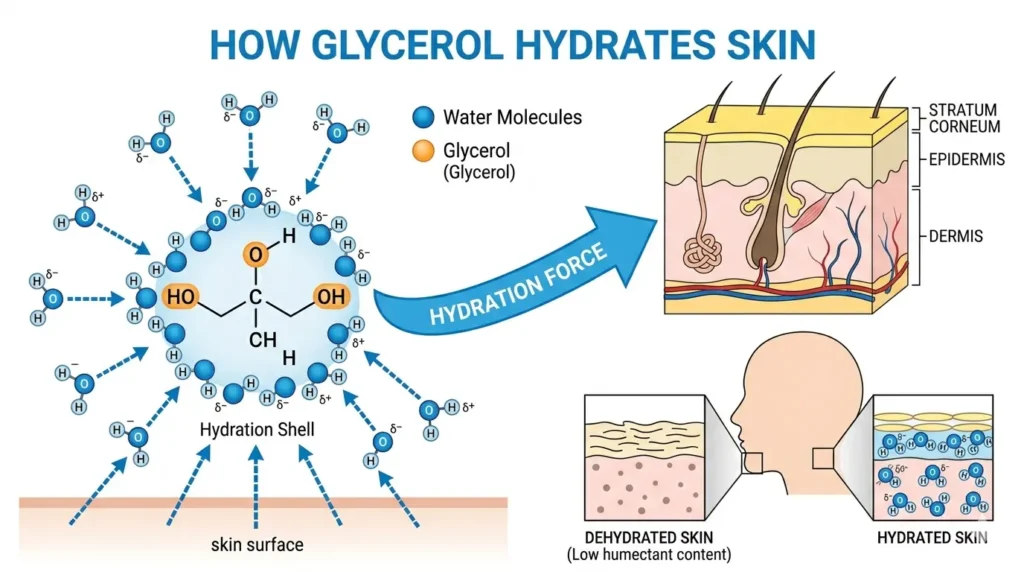
Glycerin, also called glycerol, is a clear and odorless humectant with three hydroxyl (OH) groups. A humectant is an ingredient that attracts water and helps hold it in the outer layer of the skin, called the stratum corneum.
That matters because cleansing does not only remove dirt. It can also remove natural oils and moisture-supporting compounds from the skin surface. When glycerin is present in a cleanser, it helps reduce that drying effect by supporting hydration during and after washing.
This is why glycerin soap often feels softer, less stripping, and more comfortable than regular alkaline soap — especially for people who already struggle with dryness, flaking, or irritation.
Did you know?
Glycerin is part of your skin’s own biology A PubMed review on skin hydration mechanisms confirmed that glycerol exists in the stratum corneum as a natural endogenous humectant. Your body produces glycerin in sebaceous glands and transports it to the stratum corneum via aquaporin-3 (AQP3) channels. Topical glycerin in soap supplements a system your skin already relies on.
Source: Skin hydration: a review on its molecular mechanisms. PubMed NCBI, PMID 17524122.
What this means for your skin: Glycerin is not just a “moisturizing marketing word.” Your skin naturally uses glycerol as part of its hydration system. A well-formulated glycerin soap supports that system better than a harsh alkaline soap that strips moisture away.
How glycerin gets into — and out of — your soap
Glycerin is a natural by-product of the saponification process used to make traditional soap. In most mass-market soap manufacturing, this glycerin is extracted and sold separately to the pharmaceutical and cosmetics industries — leaving you with soap stripped of its skin-conditioning component. Glycerin soap retains or re-adds glycerin, typically at 10–20% or more of the formula. This single difference explains most of the clinical outcome gap between the two.
Section 2: What Research Says About Glycerin Soap vs Regular Soap

Study 1: The University of Miami Forearm In-Use Trial (Wiley Journal of Cosmetic Dermatology, 2022)
Published by Khosrowpour et al. at the Shahid Beheshti University of Medical Sciences and University of Miami Miller School of Medicine, this study applied four cleansing types — alkaline soap, creamy soap, glycerin soap, and syndet — to four groups of 15 healthy subjects washing their forearm at least four times daily for seven consecutive days. Biophysical parameters — TEWL, erythema, friction, and skin pH — were measured using the validated Cutometer MPA 580 at multiple time points.
Key findings:
- Alkaline soap: caused the most significant increase in skin pH and TEWL at all time points, plus measurable erythema — confirming barrier disruption
- Glycerin soap: showed measurably lower TEWL and erythema. The paper stated directly: ‘the addition of compounds such as glycerin can modify these effects’
- Syndet: showed the least overall skin disruption with significant pH decrease at final measurement
Authors’ conclusion: ‘Alkaline-based soaps could cause erythema and increase TEWL and skin pH due to their strong cleansing action, and the addition of compounds such as glycerin can modify these effects.’
Study 2: Hydration and Skin Barrier Benefits from High-Glycerine Soap Bars (ResearchGate/JAAD, 2023)
A 2023 study by Sethna, Ghatlia, Majumdar, and Sachdev — affiliated with the Journal of the American Academy of Dermatology — examined biophysical skin parameters following use of high-glycerine soap bars. The study found that high-glycerine soap bars delivered measurable skin barrier benefit and hydration improvement compared to low-glycerine or non-glycerine formulations — consistent with glycerin’s established humectant mechanism.
Study 3: Glycerin’s Moisture Retention Mechanism (Nature Scientific Reports, 2022)
Published in Nature Scientific Reports, this study applied gravimetric analysis, TEWL analysis, and differential scanning calorimetry to quantify glycerin’s moisture-retention capacity at different concentrations. Key finding: moisture-retention capacity increased proportionally with glycerin concentration up to 60-70 wt%, at which point virtually no weight change occurred during evaporation — meaning higher-glycerin formulas deliver more durable hydration. This explains why glycerin concentration in the ingredient list directly predicts how much benefit a soap delivers.
Study 4: The Aquaporin-3 (AQP3) Connection — NIH-Funded PNAS Research
NIH-funded research published in PNAS studied aquaporin-3 (AQP3) — the protein channel that transports glycerol from the dermis to the stratum corneum. Using AQP3-deficient mice, the study showed that absence of this glycerol transport channel caused measurably impaired skin hydration, elasticity, and barrier recovery. Critically, oral glycerol administration fully corrected all three defects — demonstrating glycerol is not merely a cosmetic additive but a physiologically essential skin component. Topical glycerin in soap therefore supplements a mechanism skin is biologically designed to use.
Study 5: 20% Glycerin and Skin Barrier Strengthening — PubMed Clinical Trial
A 10-day clinical application of a cream containing 20% glycerin to normal skin showed significantly increased skin hydration values (corneometer) and measurably improved resistance to surfactant-induced irritation — meaning the skin became better at defending itself against the kind of damage regular soap causes. This is the ‘barrier-strengthening’ effect of glycerin, beyond simple moisturisation.
Section 3: Is Glycerin Soap pH Better Than Regular Soap?
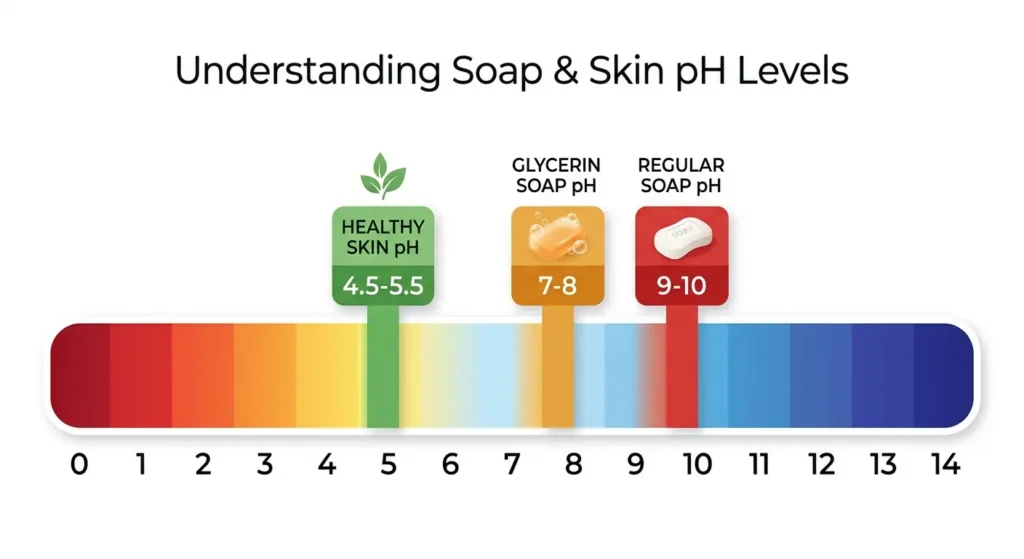
Most regular soaps are alkaline, often around pH 9–10. Many glycerin soaps are still above the skin’s ideal acidic range, but they are often less harsh than traditional alkaline soap. Some specially formulated glycerin soaps may be closer to pH-balanced cleansers.
For a full explanation of skin pH science, see our syndet bar science guide. Here is the specific comparison relevant to glycerin soap. For strict pH management, syndet bars are usually better than glycerin soap.
Healthy skin surface pH: 4.5-5.5. Regular alkaline soap: pH 9-10. Glycerin soap: typically pH 7-8 — still above ideal, but meaningfully closer to neutral and therefore less disruptive to the acid mantle. Some specially formulated glycerin soaps reach pH 5.5-6.
The Wiley/University of Miami study confirmed alkaline soap caused a substantial increase in skin pH at all measured time points vs. baseline, while glycerin soap’s impact was measurably less severe. This pH difference translates directly to less disruption of ceramide production enzymes, filaggrin breakdown, and the skin microbiome — all of which are explained in our soap ingredients safety guide.
Section 4: Glycerin Soap vs Regular Soap — The Full Comparison
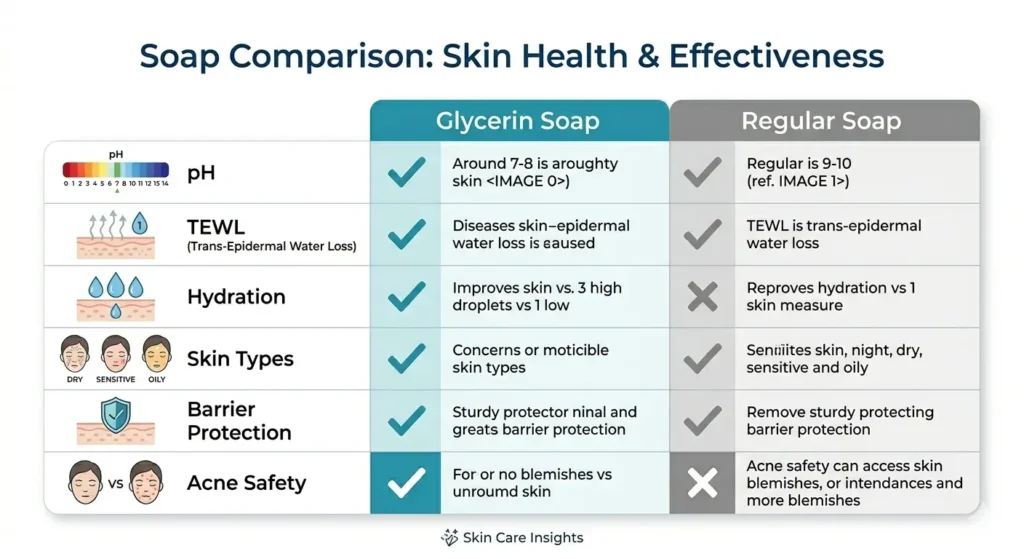
If you only want the practical difference, here it is: regular soap is mainly built to cleanse, while glycerin soap is built to cleanse while reducing moisture loss.
| Factor | Glycerin Soap | Regular Alkaline Soap |
| pH level | pH 7-8 typical; some formulas pH 5.5-6 | pH 9-10 — well above skin’s 4.5-5.5 |
| TEWL impact | Measurably lower TEWL (Khosrowpour et al., 2022) | Significant TEWL increase at all time points |
| Skin hydration | Actively attracts moisture — humectant effect | Net dehydrating — strips natural glycerin and oils |
| Erythema | Less erythema in clinical comparison | Measurable erythema with repeated use |
| Best for | Dry, sensitive, eczema, mature, normal skin | No skin type benefits over glycerin alternatives |
| Acne-prone | Non-comedogenic; controls rebound oiliness | May trigger rebound sebum overproduction |
| Lather feel | Creamy, lower foam | High foam; ‘squeaky clean’ = often over-stripped |
| Ingredient label | Usually shorter; glycerin-forward | May contain SLS, parabens, synthetic fragrance |
| Price | Slightly higher average | Generally lower cost |
Bottom line: Glycerin soap is usually a better daily choice than regular alkaline soap for dry, sensitive, and mature skin. But for severe eczema, rosacea, or very reactive skin, a pH-balanced syndet bar may still be safer.
Section 5: Skin Type Guide — Who Should Switch?
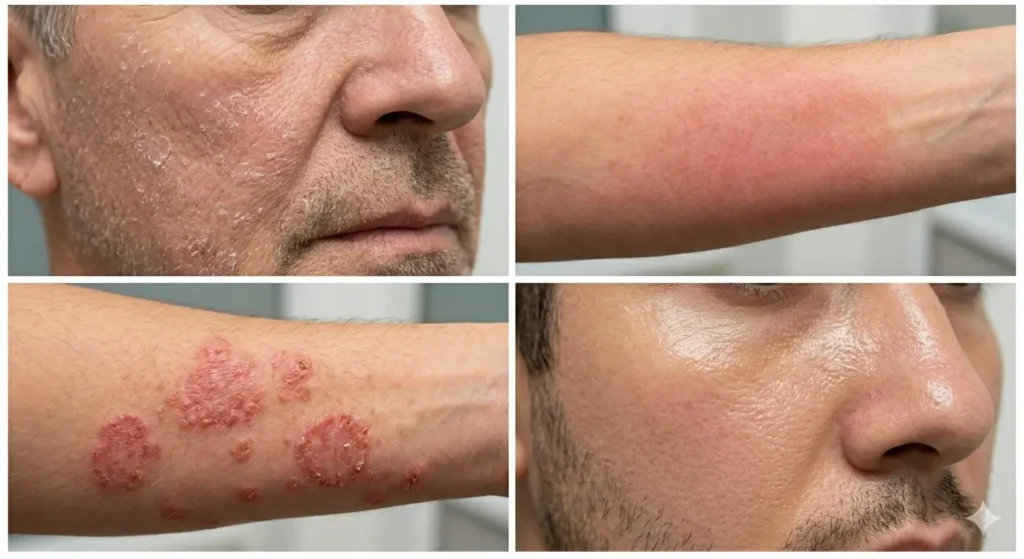
Glycerin soap is not automatically the best choice for everyone. It works best when the main problem is dryness, sensitivity, or over-stripping from harsh soap.
1. Dry and Dehydrated Skin — Strongly Recommended
Dry and Dehydrated Skin
Glycerin soap is one of the better soap options for dry skin because it helps attract and hold water in the outer skin layer. If your skin feels tight, rough, or flaky after regular soap, switching to glycerin soap may reduce that stripped feeling.
However, very dry skin usually needs more than a cleanser change. Use glycerin soap as a gentler cleansing step, then apply a moisturizer after washing to seal in hydration.
A 7-day clinical trial on 60 participants with dry skin (PMC8208277) confirmed that washing with soap alone significantly increased TEWL and skin pH — this was the control group outcome. Glycerin soap measurably reduces this harm.
2. Sensitive Skin — Recommended with Fragrance Caveat
Glycerin soap’s lower pH and humectant action make it significantly more appropriate for sensitive skin than alkaline soap. However, not all glycerin soaps are fragrance-free. Many artisan glycerin bars are heavily fragranced with essential oils — which are common contact allergens. Always choose fragrance-free glycerin soap for sensitive skin. Full ingredient safety guide: Soap Ingredients to Avoid for Sensitive Skin.
3. Eczema-Prone Skin — Strong Clinical Support
Glycerin is well-supported as a hydration ingredient for eczema-prone skin, but eczema is more complicated than simple dryness.
If your eczema is active, cracked, inflamed, or painful, a fragrance-free syndet cleanser or dermatologist-recommended cleanser may be safer than standard glycerin soap. Glycerin soap may help during calmer phases, but it should not replace prescribed eczema treatment.
A double-blind clinical study (Lodén et al.) directly compared glycerin and urea on dry, eczematous skin in atopic patients and found glycerin-based formulas produced significant improvement in skin parameters. A separate placebo-controlled, double-blind, randomised, prospective study of a glycerol-based emollient (Skin Pharmacol Physiol, 2008) has proved that glycerin is more than just a basic moisturizer. Here is what the clinical studies show:
- Boosts Deep Hydration: A high-level clinical study confirmed that glycerin-based creams significantly improve moisture levels in the skin’s outer layer.
- Helps Eczema (Atopic Dermatitis): Testing shows that it is particularly effective for those dealing with eczema, helping to repair the skin barrier.
- Scientifically Recommended: The American Academy of Dermatology (JAAD) officially includes glycerin in their 2023 guidelines as a trusted, evidence-supported ingredient for managing sensitive skin conditions.
Source: JAAD Guidelines for atopic dermatitis management 2023.
4. Acne-Prone and Oily Skin — Appropriate, with Understanding
Oily and Acne-Prone Skin
Glycerin soap can work for oily or acne-prone skin because glycerin is non-comedogenic and does not clog pores. It may also help prevent the over-drying that sometimes causes skin to produce more oil after harsh cleansing.
But if your skin is very oily or acne is active, glycerin soap alone may not be enough. You may still need targeted ingredients such as salicylic acid, benzoyl peroxide, or niacinamide depending on your skin’s needs.
5. Mature Skin — Strongly Recommended
Ageing reduces aquaporin-3 expression, lipid production, and moisture retention capacity. The NIH AQP3 research showed glycerol supplementation restored hydration, elasticity, and barrier recovery — all three markers of ageing-related barrier dysfunction. This makes glycerin one of the most evidence-supported ingredients for mature skin at a physiological level.
Who Should Be Careful With Glycerin Soap?
Glycerin soap is gentle for many people, but it is not automatically safe for every skin condition or every formula.
- Very oily skin: may need additional oil-control ingredients.
- Active eczema or rosacea: may need a pH-balanced syndet cleanser instead.
- Fragrance-sensitive skin: should avoid scented glycerin bars.
- Allergy-prone skin: should check for essential oils, dyes, and preservatives.
- Very humid climates: some glycerin soaps may feel sticky or soft if not stored properly.
Simple rule: If a glycerin soap makes your skin sting, itch, burn, or turn red, stop using it. “Natural” or “moisturizing” does not guarantee compatibility with your skin.
Section 6: Case Studies — Real Clinical Evidence
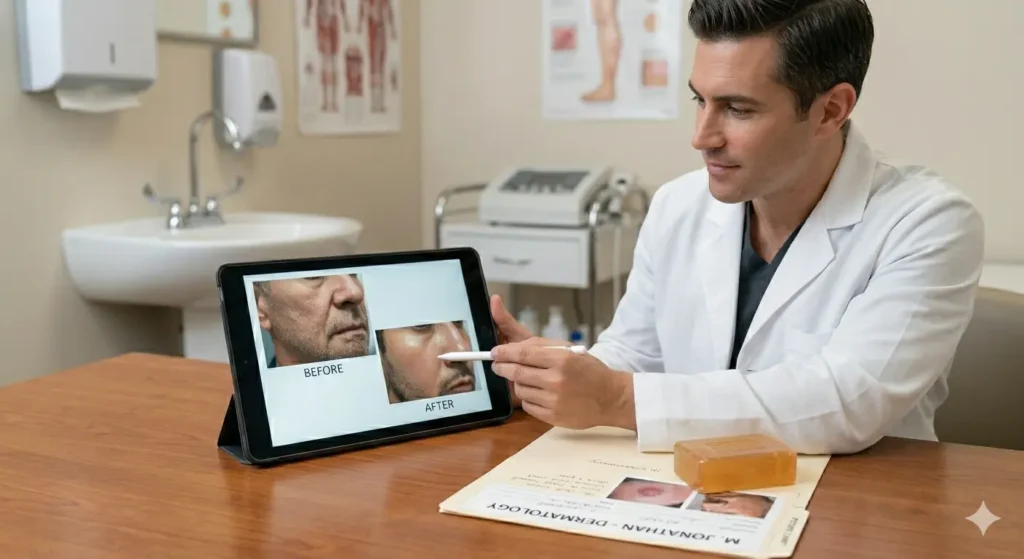
Case Study 1: Glycerol-Based Emollient on Eczematous Skin (Double-Blind RCT, Skin Pharmacology and Physiology, 2008)
This placebo-controlled, double-blind, randomised, prospective study — designed to drug-trial standards — evaluated a glycerol-based product on eczematous skin. Outcome: ‘Glycerol-based emollients have a positive influence on the skin of patients with AD. They enhance SC hydration.’ The authors confirmed the protocol was validated for drug-level efficacy evaluation, giving the findings clinical-grade credibility — not merely cosmetic marketing.
Case Study 2: The 7-Day Repeated-Wash Real-World Use Study (University of Miami, Wiley 2022)
This real-world use study asked participants to wash with their assigned soap four times daily for seven consecutive days — mimicking realistic daily use. The glycerin soap group showed lower TEWL, less erythema, and less pH disruption than the alkaline soap group at every measured time point. This is not a theoretical finding — it is real-world skin response data from a validated clinical study at a School of Medicine.
Source: Khosrowpour Z et al. J Cosmet Dermatol (Wiley). 2022;21(7):3127-3132. PMID 34741581.
Expert Voice: The AAD and Dermatology Community Position
The American Academy of Dermatology (AAD) includes glycerol among evidence-supported moisturising ingredients in their 2023 guidelines for atopic dermatitis topical care — referenced in JAAD’s systematic review of treatments. Dr. Rajani Katta, clinical professor at UT Health Science Center Houston and author of published dermatology literature, has consistently identified glycerin as a first-line recommendation for sensitive, dry, and eczema-prone skin due to its clinical track record and safety profile.
Section 7: When Glycerin Soap Is Not Enough
Limitation 1: pH is still not optimal in most glycerin soap formulas Most commercial glycerin soap sits at pH 7-8 — still above the skin’s ideal 4.5-5.5 acid mantle range. For strict pH management (active eczema, rosacea, psoriasis), a dedicated syndet bar may be more appropriate. Read our syndet bar science guide for the full clinical comparison.
Limitation 2: ‘Glycerin soap’ is not a regulated term Any soap with any amount of glycerin can be labelled ‘glycerin soap.’ The clinical benefits in this article relate to high-glycerin formulas (10-20%+ concentration). Always look for glycerin in the first 3 ingredients of the INCI list to confirm meaningful concentration.
Limitation 3: Not all glycerin soaps are fragrance-free Many glycerin bars — especially artisan varieties — are heavily fragranced with essential oils. Natural fragrance is not automatically safe for sensitive skin. Limonene and linalool (from citrus and lavender) are among the most common contact allergens in patch testing. Choose fragrance-free glycerin soap for sensitive or reactive skin. Full allergen guide: Soap Ingredients to Avoid for Sensitive Skin.
How to Choose a Good Glycerin Soap
A good glycerin soap should be more than transparent or pretty. The ingredient list matters more than appearance.
| Look For | Avoid |
|---|---|
| Glycerin in the first 3 ingredients | Glycerin listed near the end |
| Fragrance-free formula | Parfum, fragrance, or strong essential oils |
| pH information from the brand | No pH information and harsh cleansing claims |
| Simple ingredient list | Heavy dyes, glitter, or unnecessary additives |
| Non-comedogenic claim for acne-prone skin | Heavy oils if you break out easily |
Section 8: FAQs
Q1: Is glycerin soap good for your face?
Yes — one of the most clinically supported facial cleansers for dry, normal, sensitive, and eczema-prone skin. Its humectant action keeps skin hydrated during cleansing. Its pH (7-8 in most formulas) is significantly less disruptive to facial acid mantle than alkaline soap (pH 9-10). Choose fragrance-free, paraben-free, and ideally pH 5.5-6 adjusted for facial use.
Q2: Does glycerin soap lighten skin?
Glycerin does not bleach or chemically lighten skin. It improves hydration, reduces inflammatory redness, and promotes barrier function — which can make skin appear more even and luminous. It is not a whitening agent. Any product claiming glycerin causes skin lightening is making an unsubstantiated claim.
Q3: Can I use glycerin soap every day?
Yes. Clinical trials were conducted with four-times-daily use over 7 days with no adverse effects and measurable benefits confirmed. The University of Miami study confirmed glycerin’s addition to soap ‘modifies the barrier-disruptive effects’ of repetitive cleansing — making it particularly appropriate for frequent washers.
Q4: What is the difference between glycerin soap and regular soap?
(1) Glycerin content — glycerin soap retains/adds glycerin; regular soap has it extracted. (2) pH — glycerin soap pH 7-8 vs regular soap pH 9-10. (3) TEWL and erythema — clinical studies show measurably less TEWL and redness with glycerin soap. (4) Barrier impact — glycerin soap preserves and supports the barrier. (5) Lather — creamier, lower foam vs high foam.
Q5: Is glycerin soap good for oily skin?
Yes — despite the counterintuitive nature of a ‘moisturising’ soap for oily skin. Regular alkaline soap’s over-stripping triggers rebound sebum overproduction. Glycerin soap prevents this rebound response. Glycerin is also non-comedogenic. For very oily skin, pair with a niacinamide serum (2-5%) for sebum regulation.
Q6: How do I know if my glycerin soap is genuine?
Check the INCI list: glycerin must appear in the first three ingredients for a meaningful concentration. Test with a pH strip dissolved in water: genuine glycerin soap reads pH 7-8; regular alkaline soap reads pH 9-10. Look for NEA Seal of Acceptance or EWG Verified for third-party confirmation.
Q7: Is glycerin soap better than syndet bar?
For most sensitive, dry, and eczema-prone skin, a well-formulated syndet bar (pH 5.5) is the gold standard because it matches the skin’s acid mantle precisely. Glycerin soap is the next best option — significantly better than regular soap, but not yet at the acid mantle pH level that syndets achieve. For mild-to-moderate dryness and sensitivity, glycerin soap is an accessible, effective step up. For active eczema, rosacea, or psoriasis, a syndet bar is clinically preferable. Full comparison: What Is a Syndet Bar?.
Does glycerin soap dry out skin?
Glycerin soap is less likely to dry out skin than regular alkaline soap, but it can still cause dryness if it contains fragrance, harsh surfactants, or too little glycerin.
Is glycerin soap good for eczema?
Glycerin can help support hydration in eczema-prone skin, but active eczema often needs a fragrance-free syndet cleanser and proper moisturizer. Glycerin soap may help mild dryness, but it should not replace eczema treatment.
Is glycerin soap better than Dove?
It depends on the formula. Many Dove beauty bars are syndet-style cleansers and may be closer to skin-friendly pH than many glycerin soaps. For very sensitive skin, a fragrance-free syndet bar may be better than regular glycerin soap.
Section 9: Label Reading and Your Next Steps
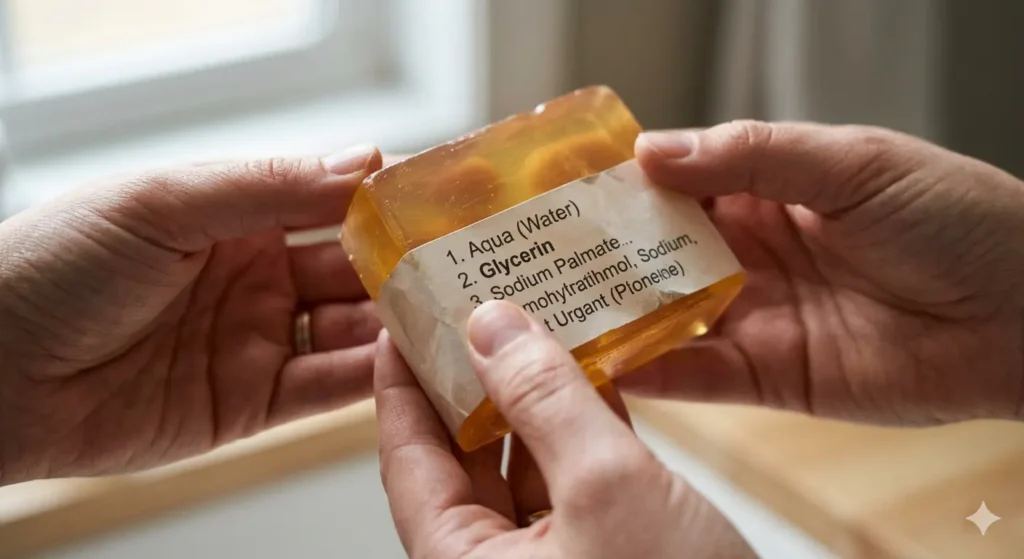
| Glycerin Soap Shopping Checklist LOOK FOR: Glycerin in first 3 ingredients (meaningful concentration) Fragrance-free label (not just unscented) pH 7-8 or lower (test with pH strip if needed) NEA Seal of Acceptance or EWG Verified for eczema/sensitive skin Non-comedogenic label if acne-prone AVOID: Glycerin listed after ingredient 5 or 6 (trace amount only) Fragrance, parfum, or essential oils blend SLS/SLES as primary surfactant alongside glycerin pH above 9 (regular alkaline soap with token glycerin) |
Sources & References — Complete Citation List
Full references below for reader and professional verification.
- Khosrowpour Z et al. Skin biophysical assessments of four types of soaps by forearm in-use test. Journal of Cosmetic Dermatology, Wiley. 2022;21(7):3127-3132. DOI: 10.1111/jocd.14589. PMID 34741581.
- Sethna S et al. Hydration and Skin Barrier Benefits from High-Glycerine Soap Bars. ResearchGate/JAAD-affiliated poster, July 2023.
- Moisture retention of glycerin solutions with various concentrations: a comparative study. Nature Scientific Reports, PMC9205919. June 2022.
- Glycerol replacement corrects defective skin hydration, elasticity, and barrier function in aquaporin-3-deficient mice. PNAS, PMC165880. NIH-funded research.
- The influence of a cream containing 20% glycerin on skin barrier properties. PubMed NCBI. PMID 18498456.
- Skin hydration: a review on its molecular mechanisms. PubMed NCBI. PMID 17524122.
- Protective Effects of Moisturizers on Skin Barrier during Regular Hand Washing with Soap Bars. PMC8208277.
- Placebo-controlled, double-blind, randomized, prospective study of a glycerol-based emollient on eczematous skin. Skin Pharmacol Physiol. 2008;21(1):39-45. PMID 18025807.
- Lodén M et al. A double-blind study comparing glycerin and urea on dry, eczematous skin in atopic patients. Acta Derm Venereol. 2002;82(1):45-7. PMID 12013198.
- JAAD Guidelines of care for the management of atopic dermatitis in adults with topical therapies, 2023. DOI: 10.1016/j.jaad.2022.12.009
- Effects of water activity and low molecular weight humectants on skin permeability and hydration dynamics. PubMed. PMID 24786192.
- American Academy of Dermatology (AAD). Dry skin tips and management guidelines. aad.org
- EWG Skin Deep ingredient database — Glycerin safety profile. ewg.org/skindeep
- National Eczema Association. Seal of Acceptance programme for eczema-appropriate products. nationaleczema.org
2026 HealthSolutionBlog.com. For educational and informational purposes only. Does not constitute medical advice. Consult a board-certified dermatologist for personalised skin health guidance.


5 thoughts on “Glycerin Soap vs Regular Soap for Skin: The Science-Backed Truth”