

Walk down any pharmacy aisle and the message is loud and clear. Natural soap: good. Chemical soap: bad. The labels practically say it for you — ‘pure,’ ‘plant-based,’ ‘chemical-free,’ versus the clinical-looking synthetic bars that do not bother with any of that language.
Here is the problem with that framing. Everything is made of chemicals. Water is a chemical. Glycerin is a chemical. Even the lye used to make traditional ‘natural’ soap is a highly caustic chemical. The natural-vs-chemical label tells you something about marketing strategy — it tells you almost nothing about how a soap will actually behave on your skin.
So what does the science actually say? Quite a bit, as it turns out. And some of it runs completely against what most people expect.
If you want a broader breakdown of soap categories before comparing natural and synthetic formulas, start with our guide to types of soap and their benefits for skin.
⚡ Quick Answer: The short version: ‘natural’ soap is not automatically gentler, safer, or better for skin. Many natural soaps have a high pH (9–11) that disrupts the skin barrier more than well-formulated synthetic cleansers. The best soap for your skin is the one formulated closest to your skin’s natural acidity — regardless of whether its ingredients come from a plant or a laboratory.
First, What Do ‘Natural’ and ‘Chemical’ Actually Mean?
These terms have no legal definition in cosmetics or skincare. In most countries — including the US, UK, and EU — no regulatory body defines what qualifies a product as ‘natural.’ Any brand can use the word on its packaging without meeting any specific standard.
In practice, people generally mean:
- Natural soap — made by saponification, the traditional process of combining plant or animal oils with an alkali (usually sodium hydroxide, or lye). Common examples: cold-process soap, Castile soap, olive oil soap, goat’s milk soap.
- Chemical or synthetic soap — made using synthesised surfactants that do not go through saponification. The most common type is the syndet bar (synthetic detergent bar), which uses gentle surfactants like sodium cocoyl isethionate or disodium lauryl sulfosuccinate.
⚠️ Watch out: The phrase ‘chemical-free’ on any product is scientifically meaningless. Every ingredient, natural or synthetic, is a chemical. What matters is which chemicals are present, at what concentration, and at what pH — not whether they were derived from a plant or made in a lab.
With that out of the way, here is where the comparison actually gets interesting.
The pH Problem With Natural Soap
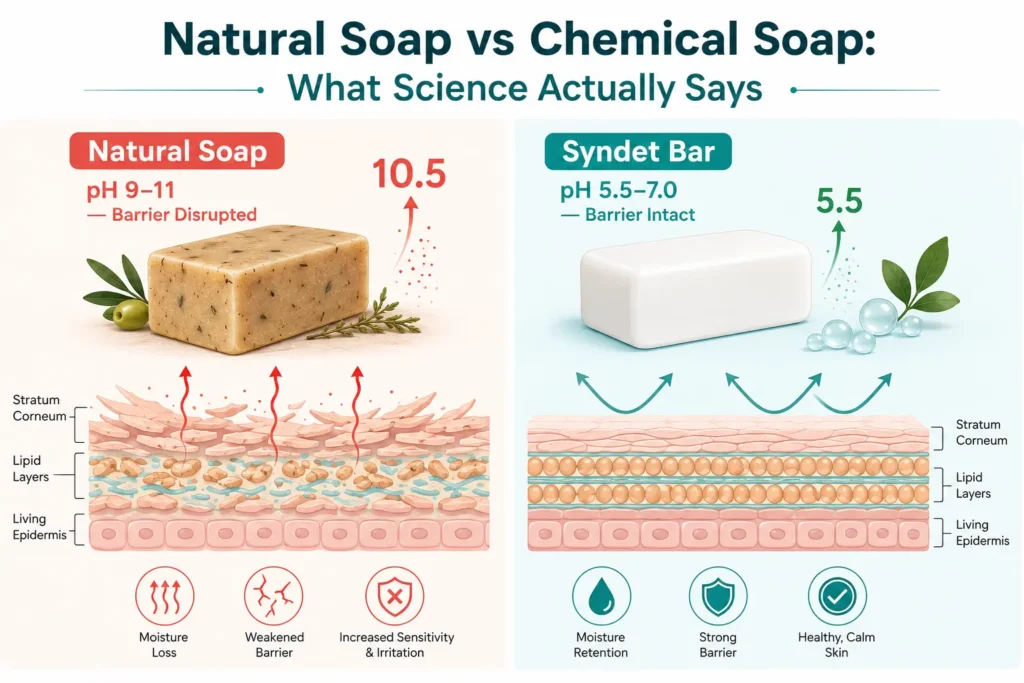
This is where most people’s intuition breaks down entirely.
Traditional natural soap — whether it is cold-process, handmade, or Castile — is alkaline. The saponification process that creates soap combines fatty acids with lye (sodium or potassium hydroxide) at a pH of around 13–14. Even after the reaction completes and the soap cures, the final product typically sits between pH 8.5 and 10.
Your skin’s natural acidity sits at pH 4.5 to 5.5. That is a gap of three to five pH units — and because the pH scale is logarithmic, that means natural soap can be 1,000 to 100,000 times more alkaline than your skin’s natural environment.
🔬 Research: A 2022 peer-reviewed review in Molecules (Mijaljica, Spada, Harrison — PMC8954092) confirmed that soap-based cleansers cause measurable barrier disruption, lipid dissolution, and pH alteration regardless of whether the ingredients are natural or synthetic. The mechanism is the same: high alkalinity. The source of the oils used is irrelevant to this outcome. [Source 1]
A 2025 double-blind study on natural soaps (MDPI Cosmetics) went further, testing both cold-process and hot-process natural soaps on 41 volunteers. Both types raised skin pH significantly after washing, with changes persisting well into the post-wash period. The study concluded that even soaps made entirely from natural ingredients caused measurable acid mantle disruption. [Source 2]
“Despite this, soap is still often preferred, possibly due to the negative connotations around anything that is not perceived as ‘natural.'” — Mijaljica et al., Molecules, 2022 — on why people continue choosing traditional soap over gentler syndets [Source 1]
💡 Tip: Want to know what pH your current soap is? Dissolve a small amount in distilled water and test it with a pH strip. A reading above 8 means it is disrupting your acid mantle every time you wash. For the full science of how soap pH affects your skin, read our dedicated guide on soap pH and the acid mantle.
For a deeper explanation of acid mantle damage, pH testing, and why cleanser pH matters so much, read our full guide on soap pH and your skin.
What Synthetic Soaps Actually Are — and Why They Often Win on Skin Safety
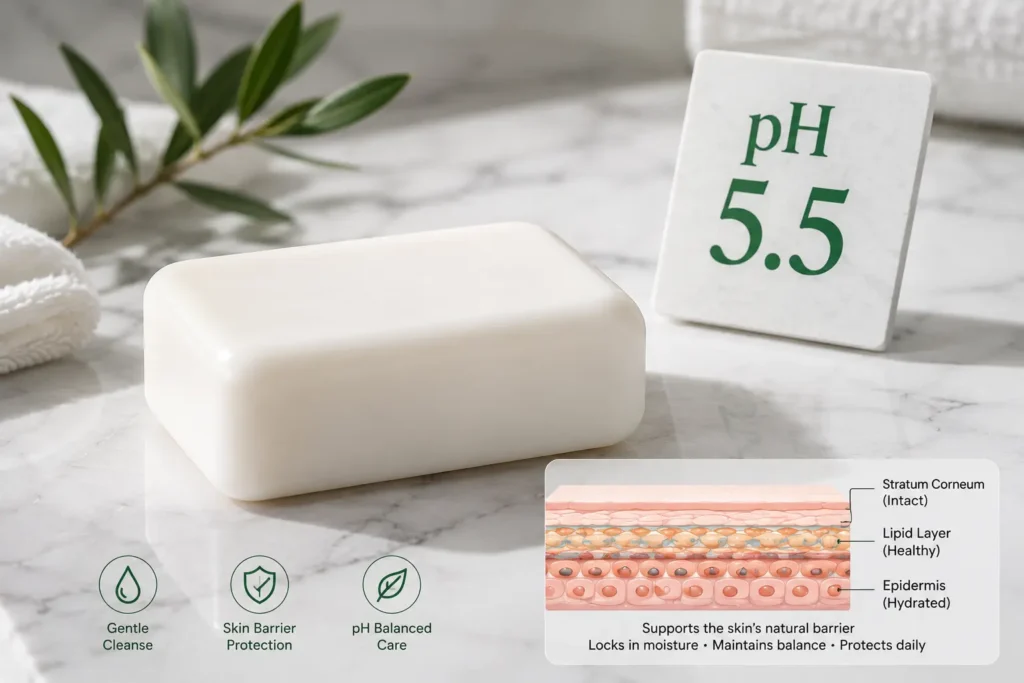
The word ‘synthetic’ carries a lot of baggage. In skincare, it tends to trigger suspicion — the assumption being that something made in a laboratory is inherently harsher or less safe than something derived from nature.
The reality is almost the opposite when it comes to cleansers.
Synthetic detergent bars, or syndets, were developed specifically to solve the problems that traditional soap creates. They use surfactants — surface-active agents — that are engineered to clean effectively at a much lower, skin-compatible pH. Sodium cocoyl isethionate (SCI), one of the most widely used syndet surfactants, is derived from coconut oil and formulated to work at pH 5.5 to 7.0.
🔬 Research: A 4-week clinical trial published in the Journal of the American Academy of Dermatology found that mild syndet bars improved multiple skin appearance attributes — texture, clarity, tone, and brightness — compared to traditional soap. The researchers attributed this to the syndet bar’s ability to maintain the integrity of the stratum corneum barrier and leave skin in a more hydrated state. [Source 3]
Pawar et al. (2024, Pharmaceutical Research) compared syndet bars and traditional soaps directly and confirmed that syndets preserve the skin’s acid mantle significantly more effectively, with lower post-wash transepidermal water loss (TEWL) elevation and faster pH recovery. [Source 4]
In practical terms: a well-formulated syndet bar is not the chemical villain its name implies. It is a precision-engineered cleanser designed to do what traditional soap cannot — clean your skin without disrupting the delicate ecosystem that keeps it healthy.
For a clearer breakdown of how syndet bars work and why dermatologists often prefer them for sensitive skin, see our guide on what is a syndet bar.
The Myth-by-Myth Breakdown
Several deeply held beliefs about natural and chemical soap do not survive contact with the research. Here are the most common ones:
❌ Myth: “Natural soap is gentler than synthetic soap”
✅ Reality: For most skin types, the opposite is true. Natural saponified soaps have a higher pH (9–11) than syndet bars (5.5–7.0), making them more disruptive to the skin barrier by chemical measurement. ‘Gentle’ is a function of pH and surfactant type — not ingredient origin.
❌ Myth: “Synthetic soap contains harmful chemicals”
✅ Reality: Synthetic surfactants like sodium cocoyl isethionate and sodium lauroyl sarcosinate have extensive safety data and are recommended by dermatologists specifically for sensitive, dry, and eczema-prone skin. The assumption that ‘synthetic = harmful’ is not supported by the dermatological evidence base.
❌ Myth: “Natural soap is chemical-free”
✅ Reality: Cold-process soap is made with sodium hydroxide (lye), a highly caustic alkali with a pH of 13–14. Glycerin, fatty acids, sodium palmitate, sodium laurate — all chemicals. Natural soap is a collection of chemicals derived from natural sources. So is synthetic soap. The difference is formulation and pH, not chemical presence.
❌ Myth: “Handmade artisan soaps are always better quality”
✅ Reality: Handmade soaps vary enormously in quality. Without pH testing, a batch can come out anywhere from pH 8 to 12 depending on how well the saponification completed. Over-lye (too much unreacted lye) produces a bar that can cause burns. Under-lye produces a greasy bar. Commercial syndet bars go through quality-controlled pH testing at every batch.
❌ Myth: “If it’s organic, it’s safe for sensitive skin”
✅ Reality: Organic refers to how an ingredient was grown, not how it behaves on skin. Organic coconut oil, organic lye, organic lavender essential oil — all can irritate sensitive skin depending on concentration and formulation. Essential oils in artisan soaps are a documented cause of allergic contact dermatitis regardless of whether they are organic.
If your skin reacts easily to fragrance, essential oils, preservatives, or harsh surfactants, our guide to soap ingredients to avoid for sensitive skin explains which ingredients deserve the most caution.
Where Natural Soap Genuinely Wins
This is not a one-sided verdict. Natural soap has real advantages — they just are not the ones usually advertised.
Environmental footprint
Traditional soap made from plant oils is biodegradable. It breaks down in waterways without persisting as a pollutant. Many synthetic surfactants, while safe for skin, take longer to biodegrade and may cause aquatic toxicity in high concentrations — though this varies significantly by surfactant type. A 2025 study in PLOS ONE confirmed natural soap is more biodegradable and less toxic to ecosystems than synthetic detergents, though it noted natural soap was less skin-friendly. [Source 5]
Ingredient simplicity
A well-made Castile or olive oil soap has three to five ingredients. Many synthetic cleansers carry longer ingredient lists including preservatives, emulsifiers, and stabilisers. For people who prefer minimal formulations, natural soap is the simpler option — provided they manage the pH issue through dilution or post-wash moisturising.
If you prefer a more moisturizing bar cleanser, it is also worth comparing glycerin soap vs regular soap, because glycerin can change how drying a cleanser feels after washing.
Plastic and packaging
Bar soaps — both natural and syndet — require far less plastic packaging than liquid body washes. Dr. Deanne Mraz Robinson has noted that from a sustainability standpoint, bar soaps (whether natural or syndet) have a meaningfully lower environmental impact than liquid cleansers packaged in plastic. [Source 6]
Skin feel preference
Some people simply prefer the feel of natural soap — the lather is different, the texture is different, and the scent (from actual plant oils rather than added fragrance) feels more authentic. If your skin tolerates natural soap without dryness or irritation, there is no compelling reason to switch.
Head-to-Head: Natural Soap vs Syndet Bar
The real difference is not “natural vs chemical.” It is pH, surfactant type, barrier impact, and how your skin responds after repeated use.
| Factor | Natural Soap | Syndet Bar |
|---|---|---|
| Typical pH | Usually pH 8.5–11, depending on formulation and curing. | Usually pH 5.5–7, closer to the skin’s natural acidity. |
| Skin barrier impact | Can disrupt the acid mantle with repeated daily use, especially on dry or sensitive skin. | Generally better at preserving the acid mantle and reducing post-wash dryness. |
| Best for sensitive skin | Often not ideal, especially if fragranced or high-pH. | Usually preferred, especially fragrance-free formulas. |
| Best for eczema-prone skin | Usually risky because alkalinity and essential oils may trigger dryness or irritation. | Often a better option, especially ceramide, glycerin, or fragrance-free formulas. |
| Ingredient simplicity | Often shorter, commonly oils, lye-derived soap salts, and glycerin. | Often longer, with surfactants, stabilizers, moisturizers, and preservatives. |
| Fragrance allergy risk | Often contains essential oils, which can irritate reactive skin. | Fragrance-free options are widely available. |
| Environmental profile | Often biodegradable and low-packaging, especially simple bar soaps. | Packaging is often minimal, but surfactant biodegradability varies by formula. |
| Best use case | Normal or oily body skin that tolerates traditional soap well. | Dry, sensitive, mature, eczema-prone, or daily facial cleansing. |
Simple takeaway: natural soap can be a good choice for some people, but syndet bars usually win for daily facial cleansing, dry skin, sensitive skin, and eczema-prone skin because they are formulated closer to the skin’s natural pH.
So Which One Should You Actually Use?
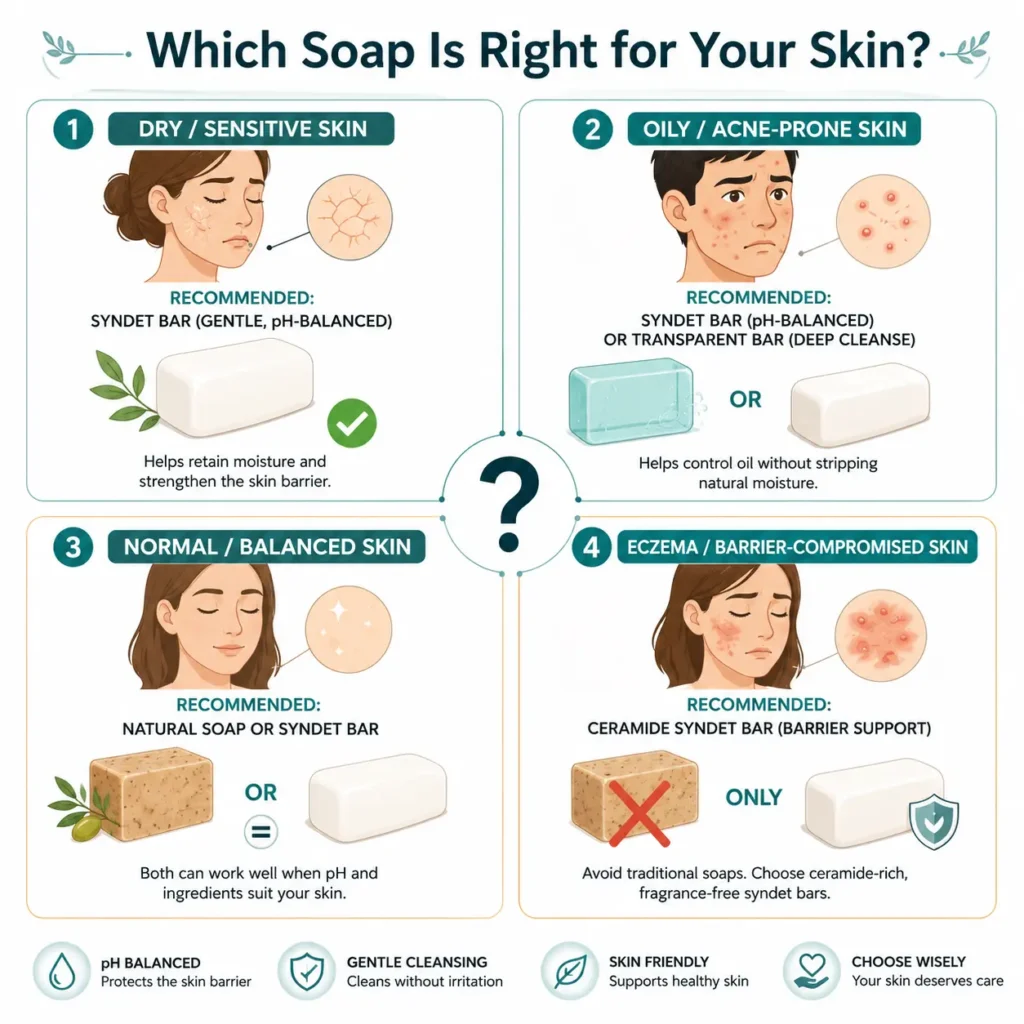
The honest answer is: it depends on your skin, not on the label.
Use a syndet bar if:
- Your skin feels tight or dry after washing with any soap
- You have eczema, rosacea, or consistently sensitive skin
- You are washing your face daily — facial skin is thinner and more pH-sensitive than body skin
- You have noticed that certain soaps trigger breakouts or flares
- You are choosing a cleanser for a child — syndet bars are far gentler on developing skin barriers
Natural soap may work fine if:
- Your skin is normal or oily and tolerates it without dryness
- You are using it on the body (not face) where the skin is thicker and less reactive
- You prefer minimal ingredients and environmental simplicity
- You can use a pH-correcting toner or moisturiser directly after washing to restore the acid mantle
- The bar has been pH-tested and sits at or below pH 8 — some well-formulated natural bars achieve this
What about for dry skin specifically?
If dryness is your main concern, the evidence is clear: syndet bars and glycerin-based bars consistently outperform natural soap in clinical trials. For a complete breakdown of the best options for dry skin with Amazon product links and research behind each one, the article on the best soap for dry skin covers exactly this.
If dryness is your main concern, the evidence is clear: syndet bars and glycerin-based bars are usually better choices than high-pH natural soap. For specific product types and skin-friendly options, read our guide to the best soap for dry skin.
Frequently Asked Questions
Is chemical soap bad for your skin?
Not automatically. “Chemical soap” is usually a misleading phrase because every soap is made of chemicals. Some synthetic cleansers, especially syndet bars, are formulated at a lower pH and may be gentler than traditional natural soap.
Is natural soap better for your skin than regular soap?
Not automatically. ‘Better’ depends on formulation and pH, not ingredient origin. Many natural soaps have a pH of 9–11, which disrupts the skin’s protective acid mantle and increases dryness and sensitivity with daily use.
A well-formulated synthetic syndet bar at pH 5.5–7.0 is typically gentler and safer for daily use, particularly for sensitive, dry, or eczema-prone skin. Natural soap may be fine for normal skin or occasional body use.
What is the difference between natural soap and chemical soap?
Natural soap is made through saponification — oils reacted with lye (sodium hydroxide) to produce soap.
Synthetic or ‘chemical’ soap (usually a syndet bar) uses engineered surfactants that clean at a lower, skin-compatible pH without the saponification process.
The key difference in practice is pH: natural soaps are typically alkaline (pH 9–11) while syndet bars are formulated near skin-neutral pH (5.5–7.0).
Does natural soap have chemicals in it?
Yes — everything is made of chemicals. Cold-process natural soap contains sodium hydroxide (lye), fatty acid salts, glycerin, and often essential oils or botanical extracts.
Calling natural soap ‘chemical-free’ is a marketing phrase, not a scientific description.
What matters is whether those chemicals are safe for your skin type and formulated at an appropriate pH.
Can natural soap cause skin problems?
Yes, in several ways. The high pH of most natural soaps can disrupt the acid mantle, leading to dryness, tightness, and increased sensitivity over time.
Essential oils used for fragrance in handmade soaps are a common cause of allergic contact dermatitis.
And inconsistently made artisan soaps can contain unreacted lye if the saponification was incomplete, which can cause chemical burns.
Is handmade soap better than commercial soap?
Handmade soap is not inherently better or worse than commercial soap — quality depends on formulation, not production method.
Artisan soaps vary widely in pH and ingredient quality. A well-made commercial syndet bar with consistent quality control and a tested pH of 5.5 will likely be better for most skin types than an untested handmade bar at pH 10, regardless of how natural the ingredients are.
Are syndet bars natural or synthetic?
Syndet bars use synthetic surfactants, but many are derived from natural sources. Sodium cocoyl isethionate — one of the most common syndet surfactants — is made from coconut oil.
The surfactant undergoes a different chemical process than saponification, which is why it achieves a lower, skin-safe pH. ‘Synthetic’ describes the process, not the ultimate origin of the ingredients.
The Bottom Line
‘Natural’ and ‘chemical’ are marketing categories, not skin-safety categories. The science is clear on one thing: what determines how a soap affects your skin is its pH and its surfactant type — not whether it was made from plant oils or synthesised in a lab.
For daily facial cleansing, for sensitive or dry skin, for eczema, and for children, pH-balanced syndet bars are consistently the better clinical choice. For body use on normal skin, for environmental reasons, or for those who simply prefer simplicity, a good natural soap can work perfectly well — provided you understand what it is doing to your barrier and compensate with a good moisturiser.
The most important thing is to stop letting labels make the decision for you. Flip the bar over. Read the ingredients. Check the pH. Your skin does not care about the marketing.
Sources
- [1] Mijaljica D., Spada F., Harrison I.P. (2022). Skin Cleansing without or with Compromise: Soaps and Syndets. Molecules, 27(6), 2010. https://doi.org/10.3390/molecules27062010 — PMC8954092
- [2] Evaluating Skin Acid-Base Balance After Cold-Processed and Hot-Processed Natural Soaps. MDPI Cosmetics, 12(3), 120. 2025. https://www.mdpi.com/2079-9284/12/3/120
- [3] Cosmetic benefits of mild cleansing syndet bars versus soap. Journal of the American Academy of Dermatology, 2005. https://www.jaad.org/article/S0190-9622(04)03133-0/fulltext
- [4] Pawar M. et al. (2024). A Comparative Study of Soap and Syndet Bars. Pharmaceutical Research, 8(3). https://medwinpublishers.com/OAJPR/
- [5] Kanyama T. et al. (2025). Natural soap is more biodegradable and less toxic than synthetic detergents. PLOS ONE. DOI: 10.1371/journal.pone.0324842 — PMC12176228
- [6] Dr. Deanne Mraz Robertson. Bar soap vs liquid soap environmental impact. Yahoo Shopping / HuffPost, March 2026.
Medical Disclaimer: This article is for educational purposes only and does not constitute medical advice. Consult a board-certified dermatologist for personalised skincare guidance.
RELATED ARTICLES (add as block at bottom of post):


3 thoughts on “Natural Soap vs Chemical Soap: What Science Actually Says”