

Your soap probably feels clean. It lathers well. It smells fine. But there is something it might be doing to your skin that you cannot feel in the moment — and by the time you notice the dryness, tightness, or breakouts it causes, you have already been using the wrong product for years.
The problem is pH. And it is simpler than it sounds.
This guide explains what soap pH actually means, what your skin’s natural acidity does for you, why the gap between most soaps and your skin matters, and exactly what to look for when choosing a cleanser. No chemistry degree required.
Quick Answer:
Healthy skin naturally stays slightly acidic at around pH 4.5–5.5. Most traditional soaps are highly alkaline, usually around pH 9–11.
That mismatch can damage the skin barrier, increase dryness, worsen sensitivity, and disrupt the skin microbiome over time.
For daily use, dermatologists usually recommend pH-balanced cleansers, syndet bars, or soap-free cleansers closer to pH 5.5–7.
What Is pH and Why Does Your Skin Have One?
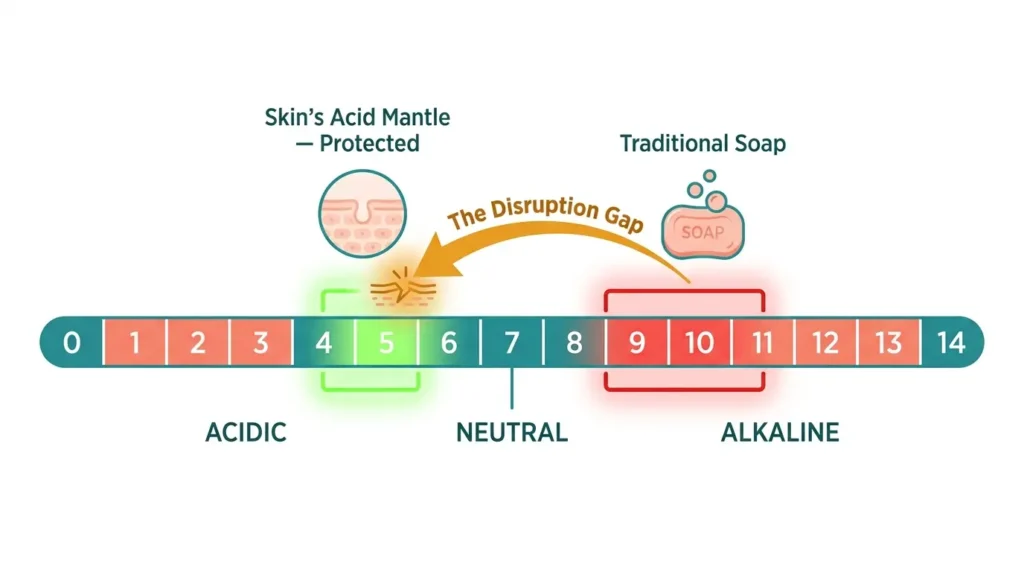
pH stands for ‘potential of hydrogen.’ It is a scale from 0 to 14 that measures how acidic or alkaline something is. A pH of 7 is neutral — pure water. Anything below 7 is acidic. Anything above 7 is alkaline (also called basic).
Your skin sits naturally at a pH of 4.5 to 5.5. That makes it mildly acidic — by design.
This surface acidity is maintained by a thin film on your skin called the acid mantle. It is produced by a combination of sebum (your skin’s natural oil), sweat, and metabolic processes within the skin cells themselves. The acid mantle is invisible, has no smell, and you cannot feel it — but it is one of your skin’s most important protective systems.
🔬 Research Says: A 2025 review published in the Journal of Investigative Dermatology confirmed that the skin’s acid mantle helps regulate the microbiome, maintain barrier stability i.e. stratum corneum, and control inflammation.[1]
What the Acid Mantle Actually Does
Think of the acid mantle as your skin’s invisible security system. It does three jobs simultaneously:
- Keeps good bacteria in, bad bacteria out. The slightly acidic environment favours the commensal (friendly) bacteria that protect your skin — like Cutibacterium acnes species that fight off more harmful pathogens. Raise the pH and you roll out the welcome mat for Staphylococcus aureus and other opportunistic bacteria. [2]
- Activates enzymes that hold your skin together. Two key enzymes — serine proteases and lipid-processing enzymes — only work properly at an acidic pH. They regulate how your skin cells mature, shed, and form the tight lipid matrix that keeps moisture in. Disrupt the pH and these enzymes malfunction, leading to dry, flaky, rough skin. [3]
- Maintains your moisture barrier. The stratum corneum’s lipid structure — the ‘mortar’ between skin cells — depends on an acidic environment to stay stable. Alkaline conditions dissolve these lipids, raising transepidermal water loss (TEWL) and leaving skin unable to stay hydrated regardless of how much moisturiser you apply. [1]
“The acid mantle is a buffer system located in the upper stratum corneum. By sustaining an acidic environment, it contributes to the regulation of the microbiome, structural stability, and inflammation. Shifts in pH can disrupt barrier properties.” — Brooks SG et al., Journal of Investigative Dermatology, 2025 [1]
What pH Does Most Soap Have — and Why That’s a Problem
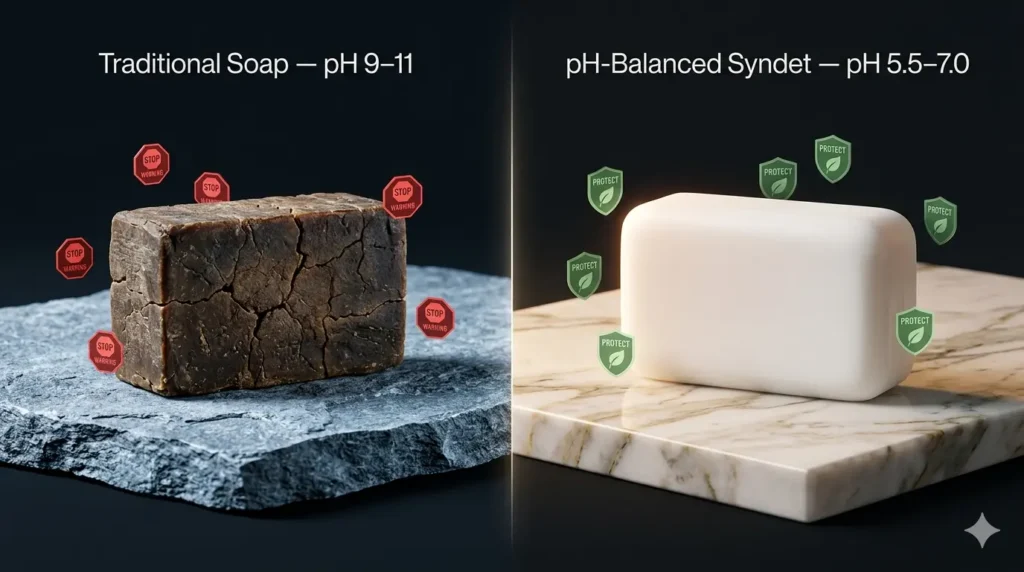
Traditional bar soaps — the kind that most people grew up with — are made through a process called saponification. Oils or fats are mixed with a strong alkali (usually sodium hydroxide, commonly called lye) to create soap. This chemical reaction leaves the final product at a pH of 9 to 11.
That is a big problem for your skin. Here is why.
Because pH is a logarithmic scale, each unit represents a tenfold difference. A soap at pH 10 is not just slightly more alkaline than your skin at pH 5 — it is 100,000 times more alkaline. At pH 11, the difference reaches one million times.
🔬 Research Says: A 2025 double-blind pH monitoring study on 41 healthy volunteers (MDPI Cosmetics) found that both cold-process and hot-process natural soaps caused significant skin pH increases that persisted well after washing — directly associated with disruption of the acid mantle and reduced skin buffering capacity. This occurred even with soaps labelled ‘natural’. [4]
Research published in the Indian Journal of Dermatology confirmed that washing with alkaline soaps raises skin pH by an average of three units — and this elevated pH can persist for up to 90 minutes after washing. With frequent washing throughout the day, the skin never fully recovers its natural acidity. [3]
⚠️ Watch Out: The phrase ‘natural soap’ does not mean ‘pH-safe soap.’ Cold-process natural soaps made with plant oils and lye still produce an alkaline end product (pH 8.5–10). Marketing claims about ingredients cannot override the chemistry of saponification.
What Happens to Your Skin When pH Is Disrupted
When the skin barrier becomes disrupted repeatedly, the effects eventually become noticeable in daily life. pH disruption produces real symptoms you have probably already experienced without knowing the cause:
- Tight, dry feeling after washing — your lipid barrier has been temporarily dissolved
- Skin that feels fine in the shower but dry ten minutes later — TEWL has spiked as moisture escapes through the disrupted barrier
- Itching or flaking with no obvious cause — enzyme malfunction is affecting proper skin cell shedding
- Acne breakouts that worsen despite using ‘clean’ products — the altered microbiome is favouring harmful bacteria
- Eczema flares after changing soap — alkaline cleansers are a documented eczema trigger
- Sensitive skin that was not always sensitive — cumulative barrier damage makes skin increasingly reactive over time
What pH Should Your Soap Be? The Evidence-Based Answer
The ideal soap pH is as close to your skin’s natural acidity as possible — between 4.5 and 7.0.
In practice, a cleanser formulated at pH 5.5 to 7.0 is considered more skin-friendly for daily use. Below pH 4.5 can cause irritation. Above pH 7.0 begins to cause measurable acid mantle disruption with repeated use.
| pH Range | Label | Skin Effect | Examples |
| 4.5–5.5 | Skin’s own pH | Optimal — acid mantle intact | Your unwashed skin |
| 5.5–7.0 | pH-balanced | Gentle — minimal disruption | Syndet bars, facial cleansers |
| 7.0–8.5 | Mildly alkaline | Moderate disruption | Some ‘mild’ soaps, baby soap |
| 8.5–10.0 | Alkaline | Significant barrier disruption | Most traditional bar soaps |
| 10.0–11.0 | Highly alkaline | Severe disruption — avoid daily | Laundry/household soaps |
Simple takeaway: The closer your cleanser is to your skin’s natural pH, the less likely it is to damage your barrier with repeated daily use.
💡 Tip: You cannot tell a soap’s pH from its colour, scent, or lather. The only reliable ways to know are: (1) check the label for ‘pH-balanced’, ‘syndet’, or ‘soap-free’, or (2) test it yourself with a pH strip — widely available for a few dollars online.
Syndet Bars: The pH-Safe Alternative Most People Haven’t Heard Of
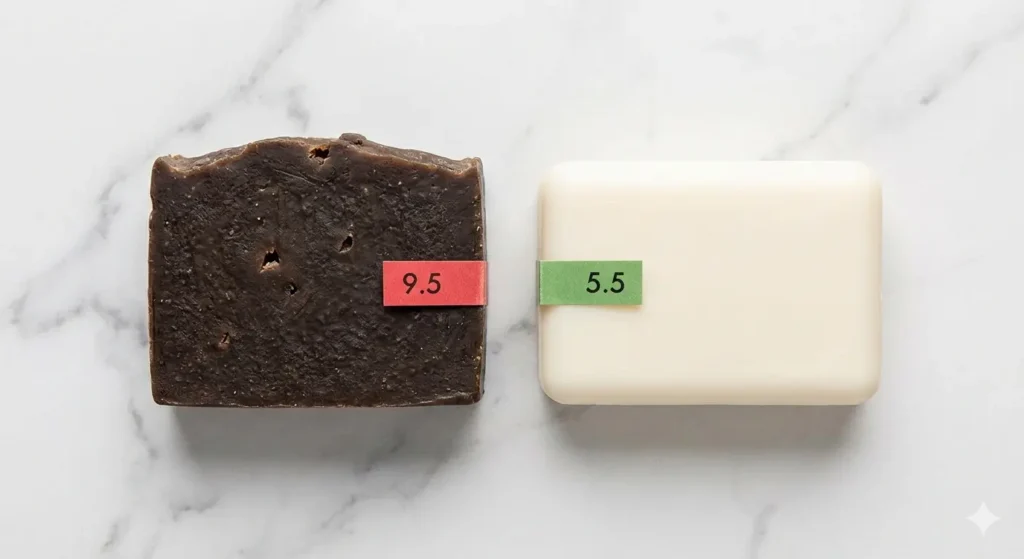
Syndet bars — short for ‘synthetic detergent bars’ — are cleansers that use non-soap surfactants instead of saponified oils. They are formulated at pH 5.5 to 7.0, making them the closest thing to a skin-neutral daily cleanser available in bar form.
A 2024 peer-reviewed comparative study in Pharmaceutical Research (Pawar et al.) confirmed that syndet bars preserve the skin’s acid mantle significantly more effectively than traditional soap bars, with measurably lower post-wash TEWL elevation and faster pH recovery times. [5]
Syndet bars are recommended by name by dermatologists including Dr. Deanne Mraz Robinson and Dr. Brendan Camp for daily use on dry, sensitive, and eczema-prone skin — precisely because of their pH compatibility with the acid mantle.
For a complete explanation of what syndet bars are, how to identify them on a label, and which surfactants to look for, read our dedicated guide: what is a syndet bar and how it protects your skin
How to Find a pH-Safe Soap — Without a Chemistry Degree
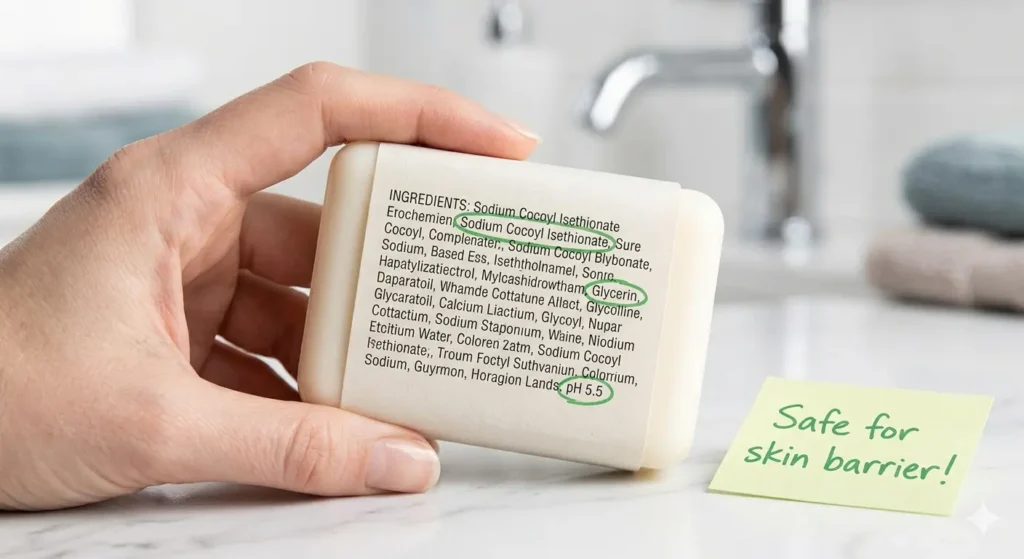
Most people do not need to memorize pH numbers. They just need to recognize a few label signals that separate gentler cleansers from harsh alkaline soap.
Green Flags — What to Look For
- ‘Syndet bar’, ‘soap-free’, or ‘pH-balanced’ on the label — these phrases directly indicate the formulation is not traditional alkaline soap
- Sodium cocoyl isethionate (SCI) as the first or second surfactant — the gentlest, most widely used syndet surfactant, formulated at skin-compatible pH
- Sodium lauroyl sarcosinate, disodium lauryl sulfosuccinate, or cocoamphodiacetate — all gentler syndet surfactants that cleanse near skin-neutral pH
- Glycerin, ceramides, or hyaluronic acid in the ingredient list — these humectants and barrier agents pair well with pH-balanced formulations
- ‘Developed with dermatologists’ combined with ‘fragrance-free’ — a meaningful claim when from established skincare brands
Red Flags — What to Avoid for Daily Use
- ‘Soap’ as the primary ingredient descriptor with no pH claim are often more alkaline than pH-balanced cleansers.
- Sodium laurate, sodium palmitate, or potassium stearate near the top — these are saponified fatty acid salts, the signature of traditional alkaline soap
- No mention of pH, syndet, or soap-free — if a bar soap makes no pH claim, assume it is alkaline
- ‘Natural’ or ‘organic’ without a pH claim — irrelevant to pH safety; natural soaps are often more alkaline than synthetic ones
- Strong lye smell in artisan or handmade bars — indicates incomplete neutralisation, potentially even higher pH
💡 Tip: Home pH test: dissolve a small amount of soap in distilled water and dip a pH strip. A reading of 9–11 confirms alkaline soap. A reading of 5.5–7.0 confirms a more skin-friendly cleanser. pH strips cost under £2/$2 on Amazon and test dozens of products.
pH-Friendly Cleansers to Consider
These cleanser types match the skin barrier principles discussed above. Choose based on your skin type, not just the word “gentle” on the label.

Dove Sensitive Skin Beauty Bar
A widely used syndet-style cleansing bar for people who want a gentler alternative to traditional high-pH soap.
Best for: normal, dry, and sensitive skin.
pH note: syndet-style bars are usually more skin-friendly than traditional soap.
Choose if: you want a simple daily bar cleanser.

CeraVe Hydrating Cleanser
A non-foaming gentle cleanser often chosen for dry or barrier-weakened skin because it cleans without a harsh stripped feeling.
Best for: dry, normal, and sensitive skin.
pH note: gentle facial cleansers are usually formulated closer to skin-friendly ranges.
Choose if: your skin feels tight after regular soap.

Vanicream Gentle Facial Cleanser
A simple fragrance-free cleanser option for people who react easily to perfumes, dyes, or unnecessary additives.
Best for: sensitive, reactive, and allergy-prone skin.
pH note: best used as a gentle alternative to alkaline soap.
Choose if: fragrance or soap bars irritate your skin.

Cetaphil Gentle Cleansing Bar
A gentle cleansing bar option for people switching away from harsh traditional soaps but still wanting a bar format.
Best for: dry, normal, and sensitive skin.
pH note: generally gentler than many regular alkaline soap bars.
Choose if: you prefer bar cleansers over liquid cleansers.

La Roche-Posay Effaclar Cleanser
A cleanser option for oily or acne-prone skin that may need more oil control than a basic gentle bar.
Best for: oily, acne-prone, and combination skin.
pH note: acne-prone skin still benefits from avoiding harsh alkaline soap.
Choose if: regular soap makes your skin oily again quickly.
Disclosure: Product formulas and ingredients can change, so always check the label before use. This section is educational and does not replace dermatologist advice.
Soap pH for Specific Skin Conditions
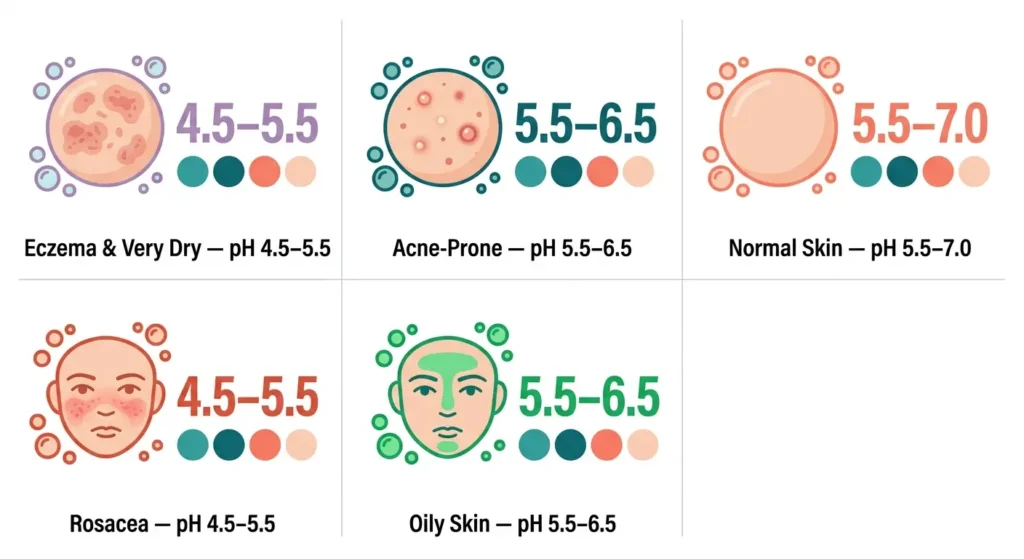
Eczema and Very Dry Skin — Strictest pH Requirements
Research published in MDPI Cosmetics (2025) confirms that skin affected by eczema has a significantly higher resting pH than healthy skin — meaning the acid mantle is already compromised. Washing with an alkaline soap compounds this damage severely. For eczema and very dry skin, target cleansers at pH 4.5–5.5 specifically. A syndet bar or glycerin-based cleanser at this range is the recommendation. [4]
For specific product recommendations in this category, see our evidence-backed guide to the best soap for dry skin.
Acne-Prone and Oily Skin — Balance Is Key
A common mistake: using high-pH soaps or antibacterial bars to ‘degrease’ acne-prone skin. High-pH cleansers strip sebum aggressively, triggering compensatory sebum overproduction — the skin responds to perceived dryness by producing more oil. This worsens acne over time.
For acne-prone skin, a syndet bar or gel cleanser at pH 5.5–6.5 is the evidence-supported choice. If using a medicated acne wash (benzoyl peroxide or salicylic acid), look for formulations where the active ingredient is delivered at a low-pH base rather than in a traditional soap vehicle.
Rosacea — Most pH-Sensitive Skin Type
Rosacea-prone skin has a measurably compromised acid mantle and a chronically elevated skin pH — research confirms this is both a cause and a consequence of rosacea flares. Even mildly alkaline cleansers (pH 7–8) can trigger flushing and inflammation in rosacea.
Normal Skin — Still Worth Protecting
If your skin has no obvious condition, a cleanser at pH 5.5–7.0 is appropriate. The temptation for people with normal skin is to use whatever is convenient. But research shows cumulative acid mantle damage from years of alkaline soap use is a primary driver of the increasing skin sensitivity many people experience in their 30s and 40s. A pH-compatible cleanser now prevents that trajectory.
Frequently Asked Questions
What pH should my face wash be?
Your face wash should ideally have a pH between 4.5 and 6.5. Facial skin is thinner and more sensitive than body skin, and it is washed more frequently — making pH compatibility especially important. Avoid any face wash with a pH above 7.0 for daily use. Most dedicated facial cleansers (gel, foam, micellar water) are already formulated at pH 5.0–6.5. Syndet bars are the closest equivalent for those who prefer bar format.
Is a pH of 5.5 good for skin?
Yes — pH 5.5 is considered the ideal cleansing pH for most skin types. It is slightly above your skin’s natural acidity (4.5–5.5) but close enough that the acid mantle can recover quickly and completely between washes. Most dermatologist-recommended cleansers, including CeraVe, Vanicream, and La Roche-Posay Effaclar, are formulated at or around pH 5.5.
Can I test my soap’s pH at home?
Yes. Buy a pack of pH strips (narrow range 4–8 strips give more accurate readings for soap testing). Dissolve a small amount of soap in a tablespoon of distilled water — not tap water, which has its own pH — and dip the strip for 10 seconds. Compare to the colour chart. A reading below 7.0 is skin-compatible. Above 8.0 indicates an alkaline soap that will disrupt the acid mantle with daily use.
Does a soap’s pH change when it gets wet or worn down?
The pH of a soap bar is relatively stable throughout its life. However, when you add water and form lather, the active pH that contacts your skin is the pH of that soap-water solution — which may differ slightly from the bar’s surface pH. Syndet bars are more pH-stable in lather than traditional soaps. This is one reason dermatologists prefer them: consistent, predictable pH at the point of skin contact.
Is baby soap pH-balanced?
Some are, but not all. The ‘gentle for babies’ label does not guarantee a specific pH. Many traditional baby soaps test at pH 7.0–8.5 — above the ideal range for infant skin, which has a naturally higher resting pH (around 6.5) that needs additional, not less, protection. For infant skin, look specifically for ‘syndet’ or ‘soap-free’ on the label, or products explicitly stating pH 5.5–6.5.
Does water pH affect my skin?
Yes — hard water (high mineral content, often pH 7.5–8.5) can raise skin pH slightly after washing and leave mineral deposits that disrupt the skin barrier. This is one reason some people find their skin significantly dries out when they move to a hard-water area. Using a low-pH cleanser partially compensates for hard water effects.
Summary
You do not need to obsess over pH numbers or turn skincare into chemistry homework.
But understanding one simple idea — that your skin naturally prefers a slightly acidic environment — can completely change how you choose cleansers.
The five things that matter:
- Your skin’s natural pH is 4.5–5.5. Anything that raises it significantly — and holds it there — damages your protective barrier.
- Most traditional bar soaps have a pH of 9–11. That is not a small difference. It is a 100,000 to 1,000,000 times more alkaline environment than your skin expects.
- Tightness, dryness, sensitivity, and breakouts after washing are often pH disruption symptoms — not signs that your skin ‘needs a stronger cleanser.’
- The fix is simple: switch to a syndet bar or soap-free cleanser labelled pH-balanced, formulated at pH 5.5–7.0. Check that the first surfactant is SCI, sodium lauroyl sarcosinate, or a similar gentle alternative.
- ‘Natural’ soap does not mean ‘pH-safe.’ Cold-process natural soaps made with plant oils and lye are still alkaline (pH 8.5–10). Nature does not dictate pH safety — formulation does.
🔬 Research Says: A 2025 review in the Journal of Investigative Dermatology concluded that pH-targeted skincare therapies — including pH-optimised cleansers — represent ‘a promising approach for advancing the management of skin conditions,’ with particular evidence for eczema, acne, and barrier repair. This is not fringe science. It is the current direction of mainstream dermatology. [1]
Sources
All clinical claims in this article are drawn from peer-reviewed, indexed research. Click links to read original sources.
- [1] Brooks SG, Mahmoud RH, Lin RR, Fluhr JW, Yosipovitch G. (2025). The Skin Acid Mantle: An Update on Skin pH. Journal of Investigative Dermatology, 145(3):509–521. https://doi.org/10.1016/j.jid.2024.07.009
- [2] The Acid Mantle Reimagined: Stepwise pH Zonation in the Stratum Corneum. Journal of Investigative Dermatology, 145(11), 2025. https://www.sciencedirect.com/science/article/abs/pii/S0022202X2500288X
- [3] Acid mantle: What we need to know. Indian Journal of Dermatology, Venereology and Leprology. https://ijdvl.com/acid-mantle-what-we-need-to-know/
- [4] Evaluating Skin Acid-Base Balance After Cold-Processed and Hot-Processed Natural Soaps: A Double-Blind pH Monitoring Study. MDPI Cosmetics, 12(3), 120. 2025. https://www.mdpi.com/2079-9284/12/3/120
- [5] Pawar M et al. (2024). A Comparative Study of Soap and Syndet Bars: Formulation, Benefits and Efficacy in Skin Care. Pharmaceutical Research, 8(3). https://medwinpublishers.com/OAJPR/
- [6] The Origin, Intricate Nature, and Role of Skin Surface pH in Barrier Integrity, Eczema, and Psoriasis. MDPI Cosmetics, 12(1):24. February 2025. https://www.mdpi.com/2079-9284/12/1/24
- [7] From Discovery to Modern Understanding: The Acid Mantle in Dermatology. Journal of Integrative Dermatology. https://jintegrativederm.org/doi/10.64550/joid.pemwha98
Medical Disclaimer: This article is for educational purposes only. It does not constitute medical advice. Consult a board-certified dermatologist for personalised skincare guidance.
RELATED ARTICLES BOX (add at bottom of post in WordPress):
Add these as a ‘Related Posts’ or Kadence Info Box block at the end:
- Types of Soap and Their Benefits for Skin → /types-of-soap-and-their-benefits-for-skin/
- Best Soap for Dry Skin: 7 Dermatologist-Recommended Options → /best-soap-for-dry-skin/
- Soap Ingredients to Avoid for Sensitive Skin → /soap-ingredients-to-avoid-for-sensitive-skin/
- What Is a Syndet Bar? → /what-is-a-syndet-bar/


3 thoughts on “Soap pH and Your Skin: Why It Matters and What to Look For”