

Here is the honest answer right away: neither liquid soap nor bar soap is universally better. Which one works better for your skin depends on the formula, not the format. But that answer glosses over some genuinely important differences — in pH, ingredient profiles, preservative load, and what actually happens to your skin barrier after repeated washing.
The debate gets more interesting when you look at cleanser pH research. Multiple studies show the same general pattern: traditional soap bars are usually more alkaline, while many liquid cleansers and syndet bars are closer to the skin’s natural acidic range.
That matters because skin normally stays slightly acidic, around pH 4.5–5.5. Cleansers that repeatedly push skin pH upward can disrupt the acid mantle, increase dryness, and weaken barrier function over time.
Most liquid soaps had a mean pH of 5.9, while bar soaps had a mean pH of 10.3.[1] That is not a small difference. On a logarithmic scale, that is a 2,500-fold gap in alkalinity. And pH, as our syndet bar guide explains in full, is one of the most important factors in how any cleanser interacts with your skin.
So why do some dermatologists still recommend bar soap? Why do others lean toward liquid? And what should you actually use? This guide works through it all — clearly, honestly, and without picking a side just for the sake of a conclusion.
| Quick Answer Neither liquid soap nor bar soap is automatically better. Liquid soap is often gentler for dry or sensitive skin because many formulas are lower pH and include moisturising ingredients. Traditional bar soap is often simpler, cheaper, lower-waste, and preservative-free, but many soap-based bars are alkaline and may dry or irritate sensitive skin with daily use. The best middle option is often a syndet bar: a bar-format cleanser made with mild surfactants and a skin-friendlier pH. Full explanation in What Is a Syndet Bar?. |
So the real question is not “liquid or bar?” The better question is: what is the cleanser’s pH, what surfactants does it use, and does it match your skin type?
Section 1: The Chemistry Difference — Why Format Matters More Than You Think
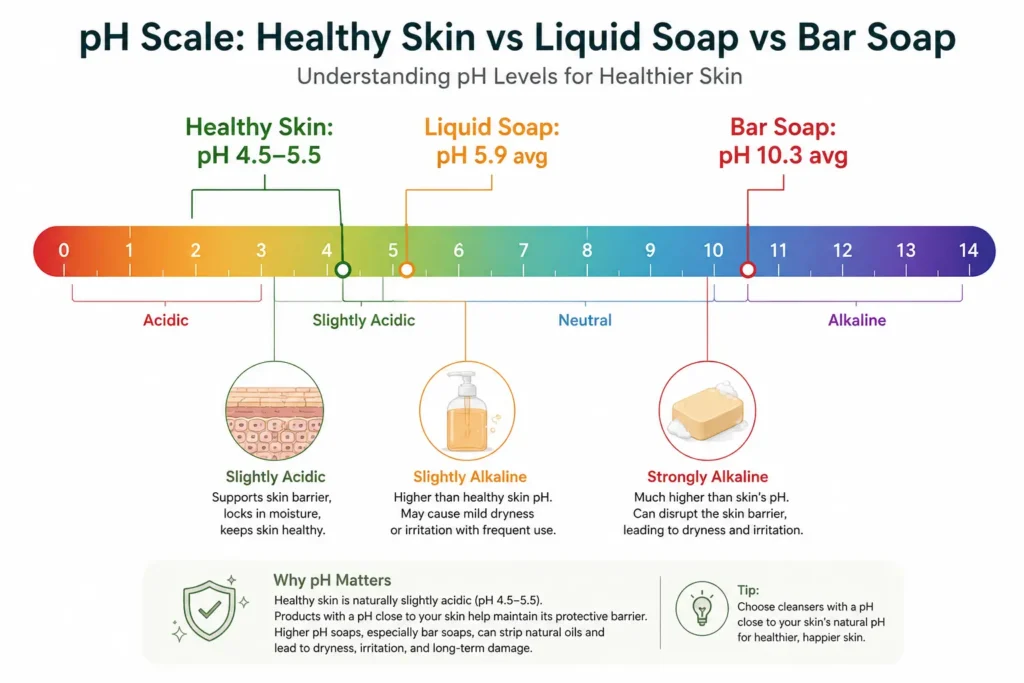
Traditional bar soap is made through saponification — reacting oils or fats with sodium hydroxide (lye). This process is effective, but it locks the finished product at pH 9–10. No amount of botanicals, oats, or essential oils changes that fundamental chemistry.
Liquid soap is typically made with potassium hydroxide instead of sodium hydroxide, producing a softer, water-soluble formula. Because it is formulated differently and contains significant water, manufacturers have much greater flexibility over final pH — which is why most commercial liquid soaps land closer to the skin-friendly range.
A 2025 study published in Heliyon (Elsevier) evaluated 22 commercial soaps — 19 bar soaps and 3 liquid hand washes. The bar soaps ranged from pH 7.01 to 10.17. The liquid hand washes, while fewer in the sample, sat in a comparatively lower range.[2]
A 2022 review in Molecules reports that soap-based cleansers commonly sit around pH 8.5–11, while syndets are usually closer to pH 5.5–7.0. That makes syndets more compatible with the skin barrier than traditional alkaline soap.
In practical terms, this pH gap means bar soap is significantly more likely to disrupt your skin’s acid mantle — the slightly acidic surface that keeps ceramides intact, the microbiome balanced, and moisture inside the barrier. We cover this mechanism fully in our companion article on what happens to skin pH and why it matters.
| The children’s skin pH finding — a useful data point A Brazilian cross-sectional study specifically evaluating children’s soaps (PMC12704940) found that bar soaps ranged from pH 8.01 to 11.01, while liquid soaps ranged from pH 4.54 to 8.00.[3] The authors concluded that bar soaps ‘do not have a pH suitable for children’s skin cleansing, whereas liquid soaps, particularly syndets, have a pH closer to the physiological range.’ While this study focused on children — who have thinner, more permeable skin — the same pH logic applies to adult sensitive and eczema-prone skin. |
Section 2: The Ingredient Difference — What Is Actually in Each?
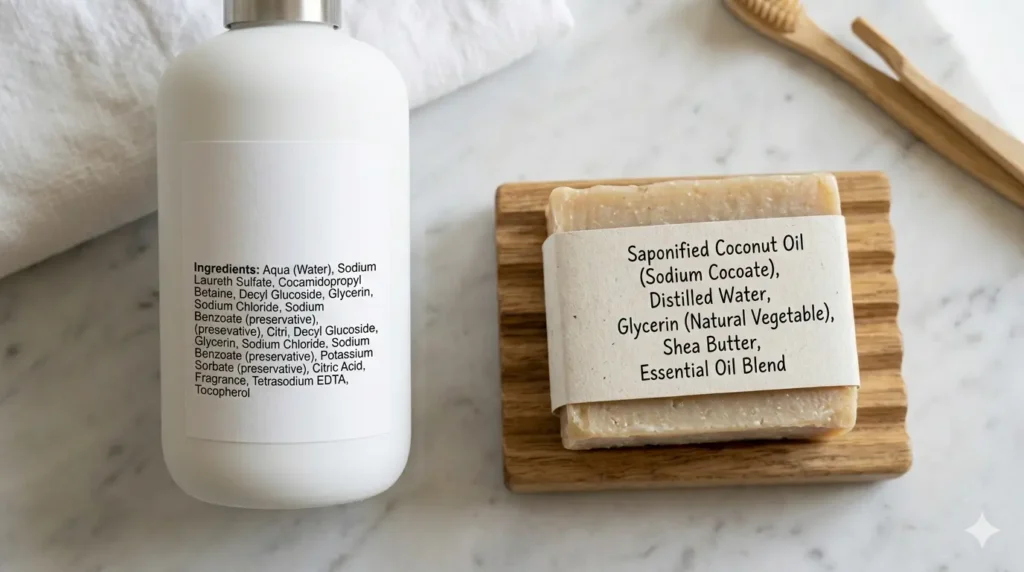
What liquid soap typically contains
Because liquid soap contains significant amounts of water — sometimes up to 80% — it requires preservatives to prevent bacterial and mould growth. This is not optional; it is a safety necessity. The most common preservatives used are:
- Parabens (methylparaben, propylparaben) — effective but linked to endocrine disruption concerns at cumulative exposure levels[4]
- Methylisothiazolinone (MI) — widely used in liquid soaps, particularly ‘eco-friendly’ formulations replacing parabens. Now classified as a significant contact allergen by the British Journal of Dermatology and the North American Contact Dermatitis Group
- Phenoxyethanol — better tolerated than MI, but still a preservative load that bar soap simply does not need
On the positive side, liquid soap’s water-based formulation allows manufacturers to incorporate humectants, emollients, and skin-conditioning agents that work during cleansing — ingredients like hyaluronic acid, glycerin, aloe vera, and ceramide precursors. These genuinely reduce dryness and TEWL compared to washing with plain alkaline bar soap.
What bar soap typically contains
Traditional bar soap has a much shorter ingredient list. The core is saponified oils (coconut, palm, olive) plus whatever fragrance or botanical additions the manufacturer includes.
Importantly: bar soap requires no preservatives because its low water content and high pH naturally prevent microbial growth. This makes it the preferred format for people wanting minimal-ingredient, preservative-free cleansing.
The tradeoff is formulation rigidity. Because of the saponification chemistry, it is very difficult to include effective concentrations of active skincare ingredients in a traditional bar soap base — they are either destroyed by the high pH or present in concentrations too low to be meaningful.
This is why syndet bars exist: they use a different base that allows pH adjustment and active ingredient inclusion simultaneously.
| The preservative paradox in ‘natural’ liquid soaps Many liquid soaps marketed as ‘natural’ or ‘eco-friendly’ have switched from parabens to methylisothiazolinone (MI) as a preservative — a compound that the European Scientific Committee on Consumer Safety has warned against in leave-on products and that the British Journal of Dermatology identified as a significant contact allergen.[5] Replacing one problematic preservative with another, less-studied one is not automatically safer. Always check the full INCI list of any liquid soap — not just the front-of-pack claims. Our full ingredient safety guide covers both: Soap Ingredients to Avoid for Sensitive Skin. |
Section 3: Which Is Better for Your Skin Type?
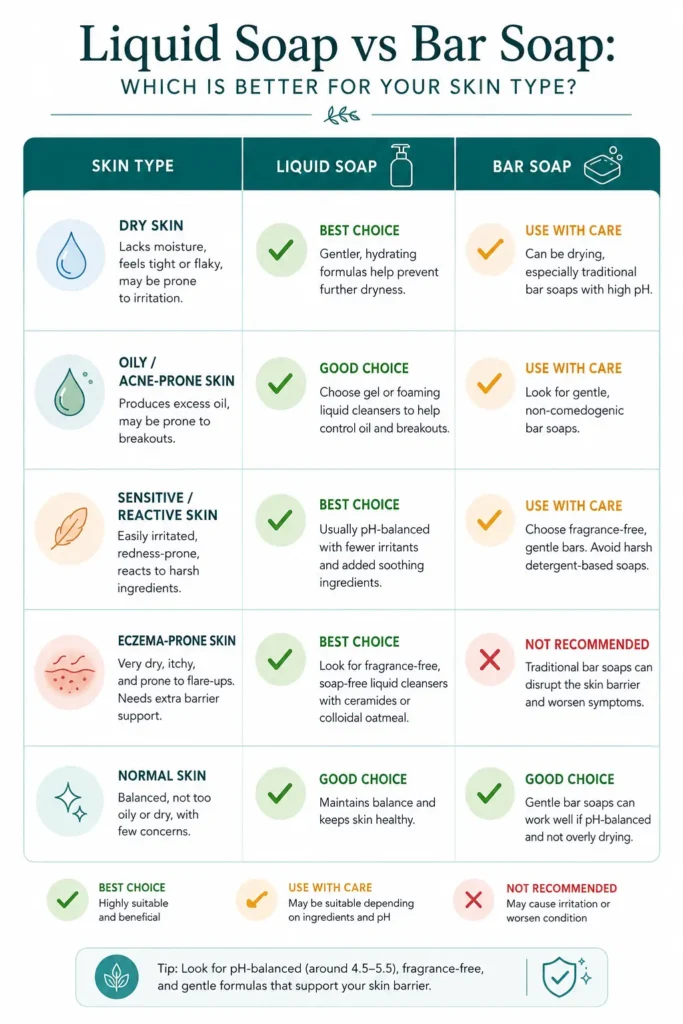
Dry and Dehydrated Skin — Liquid Soap Wins (Usually)
For dry skin, the pH advantage of liquid soap matters a lot. A bar soap at pH 9–10 strips the skin’s naturally produced ceramides and disrupts the enzyme systems that maintain the barrier — the exact same mechanisms that make dry skin drier. Liquid soap’s lower pH and the possibility of built-in humectants (glycerin, hyaluronic acid) means your barrier gets less disrupted per wash.
That said, a well-formulated glycerin bar soap or a syndet bar can match or exceed liquid soap for dry skin outcomes. The key is pH and glycerin content — not format. For the full evidence on glycerin’s role: Glycerin Soap vs Regular Soap for Skin.
Oily Skin — Bar Soap Can Work Well
Here is where bar soap gets some of its credibility back. Oily skin tolerates higher-pH cleansing better than dry or sensitive skin because its lipid reserves are more abundant — a bar soap at pH 9 does not leave oily skin as compromised as it leaves dry skin.
The stronger cleansing action of traditional soap can also feel more satisfying for removing heavy sebum. Dr. Navin Arora (board-certified dermatologist) has noted that bar soaps can be better suited to oily skin types or those preferring straightforward cleansing without added ingredients.
The risk to watch for: rebound oiliness. Over-stripping with harsh bar soap can signal the sebaceous glands to overproduce sebum — creating more oiliness, not less. We cover this mechanism in detail in our glycerin soap vs regular soap guide.
Sensitive and Reactive Skin — Depends Entirely on Formulation
This is where the format-vs-formulation distinction is most important. Traditional bar soap at pH 10 is consistently worse for sensitive skin. But a heavily preserved liquid soap with MI, synthetic fragrance, and SLS is also worse for sensitive skin. Neither format automatically wins here.
Dr. Goldbach (board-certified dermatologist) has noted that people with a history of contact dermatitis may actually do better with bar soap — specifically minimal-ingredient bar soaps with fewer preservatives, fragrances, and additives.[6]
For sensitive skin, the golden rule is: fragrance-free, preservative-minimal, shortest possible ingredient list. Both formats can achieve this — a syndet bar is often the ideal option.
Eczema (Atopic Dermatitis) — Proceed Carefully with Either
People with eczema need to be especially selective. The eczema-relevant points are:
(1) pH matters enormously — any cleanser raising skin pH above 6 can worsen the already-compromised barrier;
(2) preservative load matters — MI and parabens in liquid soaps are documented eczema triggers;
(3) fragrance of any kind — natural or synthetic — is a well-documented eczema exacerbant.
For eczema, dermatologists from the AAD and published clinical literature consistently recommend: colloidal oatmeal bars, syndet bars (pH 5.5), or fragrance-free gentle liquid cleansers free from MI and SLS. Aveeno’s colloidal oatmeal bar is recommended by multiple board-certified dermatologists as suitable for eczema-prone skin; Vanicream’s cleansing bar is similarly endorsed.[7]
For the full breakdown of which ingredients specifically worsen eczema and what to substitute: Soap Ingredients to Avoid for Sensitive Skin.
Normal Skin — Your Choice, Focus on Formulation
Normal skin is the most forgiving. Both liquid and bar soap work fine — the decision comes down to personal preference, sustainability priorities, and which format fits your routine. Focus your label-reading energy on fragrance (the most common allergen in both formats) and pH where possible.
Section 4: Liquid Soap vs Bar Soap — The Complete Side-by-Side
| Factor | Liquid Soap | Bar Soap |
|---|---|---|
| Typical pH | Often lower than traditional soap, but varies by formula. | Traditional soap bars often sit around pH 8.5–11. |
| Skin barrier impact | Can be gentler if pH-balanced and fragrance-free. | Traditional alkaline bars may disrupt the acid mantle with repeated use. |
| Preservatives | Usually needed because water-based formulas can grow microbes. | Usually not needed because low water content and high pH reduce microbial growth. |
| Moisturising ingredients | Can include glycerin, aloe, ceramides, hyaluronic acid, and emollients. | Limited in traditional soap, but syndet and glycerin bars can be more skin-friendly. |
| Ingredient simplicity | Usually longer ingredient list due to water, preservatives, and stabilizers. | Often shorter and simpler, especially traditional bars. |
| Dry skin | Often better if gentle, fragrance-free, and pH-balanced. | Traditional bars may worsen dryness; syndet bars are better. |
| Oily skin | Good if non-comedogenic and not overly stripping. | Can work for oily skin, but harsh bars may trigger rebound oiliness. |
| Sensitive or eczema-prone skin | Choose fragrance-free, alcohol-free, MI-free, gentle formulas. | Avoid high-pH traditional soap; choose syndet or fragrance-free cleansing bars. |
| Hygiene | Pump dispensers reduce shared-surface contact. | Fine for personal use if rinsed and dried between washes. |
| Environmental impact | More plastic and water weight in most cases. | Usually less packaging and lighter shipping weight. |
| Best overall use | Dry, mature, sensitive, or facial skin when the formula is gentle. | Normal or oily body skin, travel, low-waste routines; syndet bars for sensitive skin. |
Simple takeaway: liquid soap often wins for dry and sensitive skin when it is gentle and fragrance-free. Traditional bar soap wins for simplicity, cost, and sustainability. Syndet bars often give the best middle ground: bar format with skin-friendlier pH.
Section 5: The Format That Changes the Whole Debate — Syndet Bars
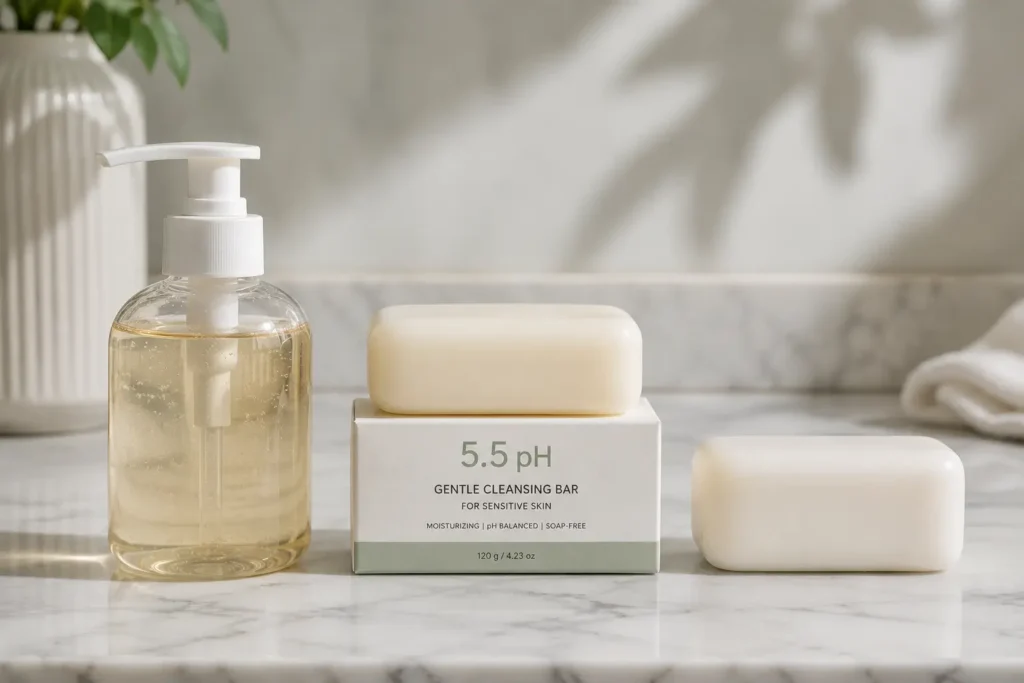
Much of the liquid-vs-bar debate assumes the only bar soap option is traditional alkaline soap. That assumption is increasingly outdated.
Syndet bars — short for synthetic detergent bars — are formulated with mild surfactants rather than saponified oils, which means their pH can be engineered to match the skin’s natural range of 4.5–5.5.
In a cross-sectional study, syndets had a mean pH of 6.0 — essentially matching liquid soap on the pH advantage while retaining the bar format’s benefits: no preservatives needed, simpler formulation, lower environmental footprint, and lower cost per use.[1]
The Brazilian children’s soap study confirmed the same finding: syndet bars ‘had pH values closer to the physiological range with lower values when compared to liquid soaps.’[3]
For dry, sensitive, and eczema-prone skin, a syndet bar is arguably the strongest recommendation — bar format, liquid-soap pH, preservative-free, and compatible with added moisturising ingredients.
This is precisely why dermatologists like Dr. Nicole Negbenebor (Brown University) specifically highlight syndet bars as a skin-friendly bar option. Read the full clinical breakdown: What Is a Syndet Bar? The Science Behind pH-Balanced Soap.
Section 6: The Bar Soap Bacteria Myth — What the Evidence Actually Shows
One of the most persistent arguments against bar soap is that it harbours bacteria. The concern is understandable — a bar sitting in a wet soap dish, handled by multiple people, does accumulate surface bacteria. But the clinical evidence complicates the scary narrative.
Studies cited by dermatologists and published in hygiene literature consistently show that while bacteria do colonise bar soap surfaces, they do not transfer to skin at clinically significant levels during normal handwashing.
The act of lathering and rinsing removes both the soap and any bacteria it may carry. No published study has linked bar soap use to increased rates of skin infection under normal household use conditions.
Practically speaking: if you live alone, this point barely applies. If you share soap with a family member who has an active skin infection, a pump dispenser is more hygienic by design.
For everyone else, storing your bar in a draining soap dish — so it dries between uses rather than sitting in standing water — is sufficient.
Research on contaminated bar soap found that bacteria were not easily transferred during normal hand washing, suggesting that personal bar soap use is generally low risk for healthy users.[8]
| When bar soap hygiene genuinely matters In healthcare or clinical settings, pump dispensers are the accepted standard for infection control — and that is entirely appropriate. For consumer home use, the bacteria transfer risk from a properly stored bar soap is low and not supported by clinical evidence as a meaningful health concern. |
Section 7: The Environmental Angle — Does It Affect Your Choice?
If sustainability factors into your purchasing decisions, the comparison is fairly clear. Bar soap requires significantly less packaging (often just paper or cardboard), has a lower carbon footprint in production and shipping (no water weight), and biodegrades more cleanly.
Liquid soap in plastic pump bottles contributes substantially more to plastic waste — and even brands using recycled plastic still require energy-intensive packaging.
A 2023 study estimated that soap packaging contributes significantly to landfill waste and microplastic pollution.[5]
Liquid soap is estimated to require five times more energy for production and up to 20 times more for packaging compared to bar soap.[8]
This does not mean everyone should switch to bar soap immediately — particularly if a liquid formula is genuinely better for your skin condition. But for those with normal skin and no specific dermatological needs, bar soap is the more sustainable default.
Frequently Asked Questions
Do dermatologists recommend bar soap or liquid soap?
Most dermatologists do not make a blanket recommendation for either format. The recommendation depends on skin type.
For dry, sensitive, or eczema-prone skin, they typically prefer liquid soap or syndet bars over traditional alkaline bar soap — because of pH and moisturising agent advantages.
For oily or normal skin with no specific concerns, either format is acceptable. Dr. Nicole Negbenebor (Brown University) notes that body washes often contain more moisturising ingredients — but dermatologist Dr. Navin Arora notes bar soaps can be better for oily skin types or simple routines.[6]
Is liquid soap more hygienic than bar soap?
From a cross-contamination standpoint, yes — pump dispensers do not get handled and do not sit in standing water.
However, clinical evidence does not show that bar soap use leads to increased skin infections under normal household conditions.
The bacteria that colonise bar soap surfaces are not transferred at significant levels during a normal wash.
For shared bathroom use in a household with vulnerable individuals (infants, immunocompromised), a pump dispenser is a reasonable preference. For personal use, a draining soap dish handles the concern adequately.
Is bar soap bad for sensitive skin?
Traditional alkaline bar soap — pH 9–10 — is not ideal for sensitive skin, because that pH level disrupts the acid mantle, impairs ceramide production, and destabilises the skin microbiome.
However, the word ‘bar soap’ covers a wide range: syndet bars and glycerin-rich bars are formulated to pH 5.5–7 and are appropriate for sensitive skin. It is the formula, not the format, that determines whether a bar soap is problematic for sensitive skin.
Can I use liquid soap on my face?
Many liquid soaps are formulated for body or hand use and may contain surfactants, fragrances, or preservatives at concentrations too high for the thinner, more sensitive facial skin.
For the face, look specifically for liquid cleansers formulated as facial washes — these are typically lower pH (5–6), lower fragrance load, and formulated with skin-appropriate surfactants.
A syndet bar or glycerin bar soap is also a well-tolerated facial cleanser option for most skin types.
Q5: Which is more eco-friendly — liquid or bar soap?
Bar soap has a significantly lower environmental footprint in most analyses: less plastic packaging, lower shipping weight (no water), and more straightforward biodegradation.
If sustainability is a priority and your skin does not require the specific benefits of a liquid formula, bar soap (or a syndet bar) is the greener choice.
Q6: What is the best soap for eczema — liquid or bar?
For eczema, the format is secondary to these criteria: fragrance-free, preservative-minimal (no MI or parabens), pH as close to 5.5 as possible, and ideally containing a barrier-supporting ingredient like colloidal oatmeal or glycerin.
A syndet bar or a well-formulated fragrance-free liquid cleanser both meet these criteria. Avoid traditional alkaline bar soap (pH 9–10) and any liquid soap containing methylisothiazolinone.
Dermatologist-recommended options for eczema-prone skin include Vanicream Cleansing Bar and Aveeno Moisturising Bar — both bar format.[7]
Q7: Does liquid soap dry out skin less than bar soap?
In general, yes — primarily because of pH.
Commercial liquid soaps average pH 5.9 vs bar soap’s pH 10.3. Lower pH means less acid mantle disruption, less ceramide enzyme interference, and less TEWL per wash.[1]
Additionally, many liquid cleansers include humectants and emollients that actively reduce dryness.
However, a glycerin-rich bar soap or syndet bar can match or outperform an average liquid soap on skin dryness — the distinction is formulation quality, not format alone.
Section 9: How to Choose — A Simple Decision Guide
| Your Quick Decision Guide Use a quality liquid soap or syndet bar if you have: Dry, dehydrated, or tight-feeling skinEczema, psoriasis, or atopic dermatitisSensitive or reactive skinRosacea or a compromised skin barrierMature skin with naturally reduced lipid production A well-formulated bar soap works well if you have: Oily or combination skinNormal skin with no specific concernsA preference for minimal ingredients and no preservativesSustainability as a priorityA budget preference or travel convenience need Use a syndet bar if you want: Bar-format convenience with liquid-soap-level pH (5.5)No preservatives — but still gentle on the skin barrierThe ideal balance of all the above → Full syndet bar guide: What Is a Syndet Bar? The Science Behind pH-Balanced Soap |
Whatever format you choose, the label check remains the same. Avoid: SLS, synthetic fragrance/parfum, parabens, methylisothiazolinone, DMDM hydantoin, and triclosan. Look for: glycerin or other humectants, pH 5.5–7, fragrance-free label, short INCI list. Complete ingredient guide: Soap Ingredients to Avoid for Sensitive Skin.
Section 10: The Full Soap Science Series on HealthSolutionBlog.com
This article is part of our ongoing skin health and cleansing science series. Each guide links back to the others where relevant throughout the article — here is the full picture for easy navigation:
- Types of Soap and Their Benefits for Skin — Complete Guide — glycerin, herbal, syndet, medicated, and toilet soap all explained with skin-type matching
- Soap Ingredients to Avoid for Sensitive Skin — SLS, fragrance, parabens, DMDM hydantoin, and 4 more — peer-reviewed evidence and a printable checklist
- Glycerin Soap vs Regular Soap for Skin — 5 clinical studies comparing glycerin soap to alkaline soap on TEWL, hydration, and erythema
- What Is a Syndet Bar? The Science Behind pH-Balanced Soap — the third format this article references — pH 5.5 bar cleansers explained from first principles
- Herbal Soap Benefits for Skin: 8 Ingredients Backed by Science — neem, turmeric, aloe vera, tea tree, colloidal oatmeal and more — what the research actually shows
Sources & References
Superscript citation numbers throughout this article link directly to their source. Full references are listed below.
Sources & References
Superscript citation numbers throughout this article link directly to their source. Full references are listed below.
- Mijaljica D, Spada F, Harrison IP. Skin Cleansing without or with Compromise: Soaps and Syndets. Molecules. 2022.
- Smrity SZ et al. Comprehensive evaluation of physico-chemical, antioxidant, and antimicrobial properties in commercial soaps. Heliyon. 2025.
- Children’s soap pH analysis and its meaning in children’s skin cleansing. NCBI/PMC.
- American Academy of Dermatology. Face Washing 101.
- American Academy of Dermatology. Eczema-friendly skincare product guidance.
- Yazar K et al. Methylisothiazolinone in rinse-off products causes allergic contact dermatitis. British Journal of Dermatology. 2015.
- American Academy of Allergy, Asthma & Immunology. Skin care tips for atopic dermatitis.
- Heinze JE, Yackovich F. Washing with contaminated bar soap is unlikely to transfer bacteria. Journal of Environmental Pathology and Toxicology. 1988.
2026 HealthSolutionBlog.com. For educational purposes only. Does not constitute medical advice. Consult a dermatologist for persistent skin conditions or concerns.


3 thoughts on “Liquid Soap vs Bar Soap: Which Is Actually Better for Your Skin?”