
Here is something most brightening soap brands do not tell you: the contact time between soap and skin is typically 30 to 60 seconds.
For an active ingredient to fade dark spots, it needs to penetrate the stratum corneum and reach melanocytes — the cells responsible for pigment production. Most rinse-off soaps do not achieve this in 60 seconds.
That does not mean soap for dark spots is useless. It means you need to be selective about which actives appear in the formulation and how they are used.
The soaps that genuinely work use tyrosinase inhibitors — ingredients that interrupt the melanin production process at a biochemical level — at high enough concentrations to deliver some effect even in a wash-off format.
This guide covers the 6 best ingredient categories for dark spot soap, what dermatologists actually say about them, realistic expectations, and verified Amazon products for each.
If you want the broader foundation first, our guide to types of soap and their benefits for skin explains how brightening bars, syndet bars, medicated soaps, herbal soaps, and traditional soaps behave differently on the skin.
⚡ Quick Answer:
The most evidence-backed ingredients for dark spot soaps:
kojic acid (tyrosinase inhibitor),
niacinamide (melanin transfer blocker),
azelaic acid (tyrosinase inhibitor),
vitamin C (antioxidant + tyrosinase inhibitor),
tranexamic acid (melanin pathway blocker), and
alpha arbutin (hydroquinone derivative).
All work better with consistent use over 8–24 weeks plus daily SPF 30+. No soap works against dark spots without sun protection.
What Causes Dark Spots — and Which Types Soap Can Help With
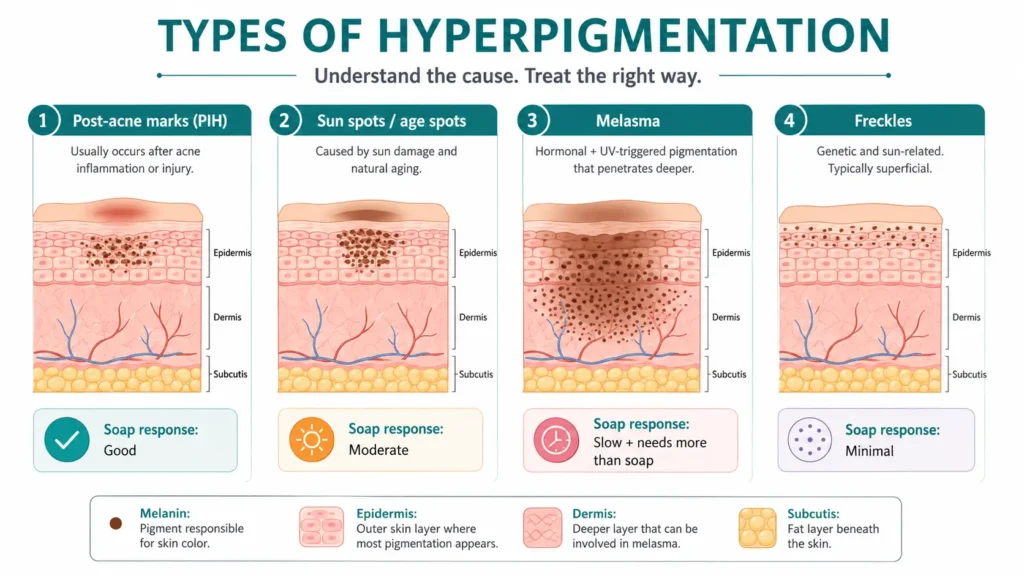
Dark spots are caused by overproduction or uneven distribution of melanin — the pigment that gives skin its colour. Melanocytes (the cells that produce melanin) can be triggered to overproduce by UV exposure, inflammation, hormones, or post-injury healing. Not all dark spots respond equally to topical soap-based actives:
Post-acne marks
Cause: inflammation after acne.
Depth: usually epidermal.
Soap response: good with consistent use and SPF.
Sun spots / age spots
Cause: cumulative UV exposure.
Depth: usually epidermal.
Soap response: moderate; needs strict sun protection.
Melasma
Cause: hormones, UV, visible light.
Depth: can be deeper and recurring.
Soap response: support only; needs leave-on treatment and SPF.
Freckles
Cause: genetics plus UV exposure.
Depth: superficial pigment pattern.
Soap response: minimal; prevention matters more.
Post-inflammatory marks
Cause: eczema, burns, cuts, friction.
Depth: epidermal to dermal.
Soap response: moderate to slow; avoid irritation.
Best case for brightening soap: shallow post-inflammatory pigmentation. Worst case: melasma without sunscreen. Soap can support fading, but it is not a standalone melasma treatment.
The most realistic expectation: soap-based brightening actives work best on shallow, epidermal hyperpigmentation — post-acne marks and sun spots. They are a supporting tool for melasma, not a standalone treatment. In all cases, daily SPF 30+ is non-negotiable — any UV exposure actively triggers more melanin production, directly counteracting the brightening soap’s work.
⚠️ Watch Out:
Hydroquinone soap products are widely sold online. Dermatologists do not recommend hydroquinone in rinse-off products for two reasons:
(1) the contact time is insufficient for meaningful effect, and
(2) long-term hydroquinone use — even in wash-off format — carries risks of ochronosis (paradoxical skin darkening) in people with deeper skin tones.
Stick to the safer tyrosinase inhibitors listed in this guide.
How Dark Spot Soap Actually Works — The Science in Plain Terms
Dark spots form through a process called melanogenesis. Melanocytes produce melanin using an enzyme called tyrosinase. UV light, inflammation, and hormonal signals all activate tyrosinase, which converts the amino acid tyrosine into melanin. The melanin then transfers to surrounding skin cells (keratinocytes), creating visible pigmentation.
Brightening soap ingredients interrupt this process at different points in the chain:
- Tyrosinase inhibitors (kojic acid, azelaic acid, alpha arbutin, vitamin C) — block or slow the enzyme that starts melanin production. Work best in the earlier stages of melanogenesis.
- Melanin transfer blockers (niacinamide, tranexamic acid) — don’t stop melanin being made but prevent it transferring from melanocytes to surrounding skin cells. Effective for preventing new dark spots and fading existing ones.
- Exfoliants (glycolic acid, lactic acid in wash-off format) — accelerate the skin’s natural cell turnover, bringing pigmented cells to the surface faster and removing them through shedding. Most effective for shallow, epidermal pigmentation.
🔬 Research:
A 2023 comparative review of tyrosinase inhibitors in cosmetic dermatology confirmed that kojic acid, azelaic acid, and niacinamide are among the best-evidenced topical brightening ingredients.
The review noted that combination formulas using multiple pathways (e.g., a tyrosinase inhibitor + a melanin transfer blocker) produce significantly faster and more consistent results than single-ingredient products. [1]
The contact time reality: in a wash-off soap, the effective window is 30–90 seconds. To maximise this, apply your brightening cleanser, leave the lather on for 60 seconds before rinsing — rather than scrubbing immediately. This small change meaningfully increases the ingredient’s interaction with skin. Dermatologist Dr. Brendan Camp specifically noted this technique for medicated and active cleansers in NBC Select (2026).
The 6 Best Soap Ingredients for Dark Spots — With Verified Amazon Products
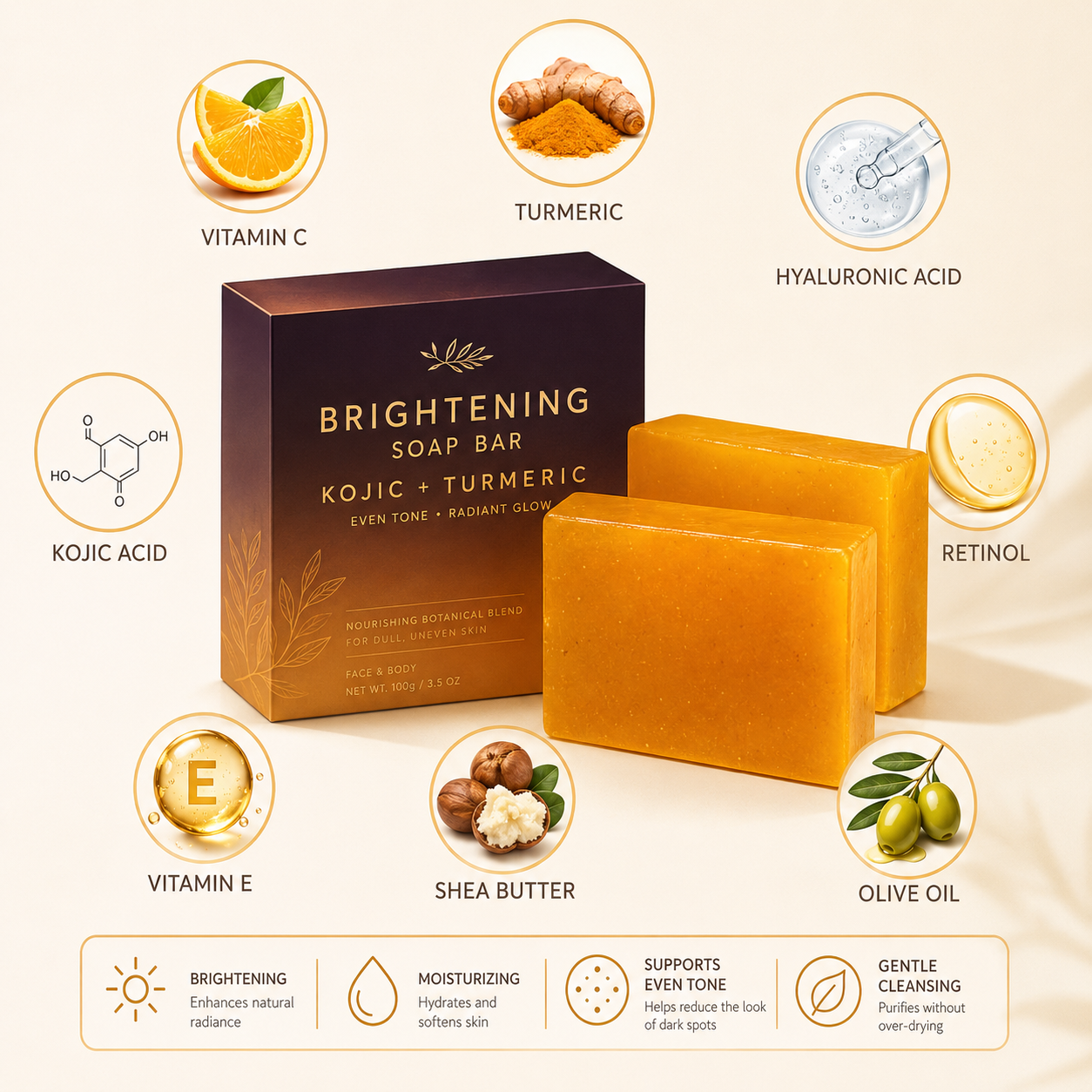
VALITIC Kojic Acid Dark Spot Remover Soap Bars
A kojic-acid-focused brightening soap direction with turmeric, vitamin C, retinol, collagen, hyaluronic acid, shea butter, and vitamin E positioning.
Kojic acid belongs to the tyrosinase-inhibitor category, which is why it is commonly used in dark spot and uneven-tone formulas.[1][2]
- Good fit for readers wanting a kojic + turmeric combination.
- Better for body areas and uneven tone than delicate/sensitive skin.
- Use with SPF or results will be limited.
2. Niacinamide Soap — Best for Preventing New Dark Spots While Fading Existing Ones
- Best for: Post-acne hyperpigmentation, combination skin with uneven tone, prevention of new spots
- Mechanism: Blocks melanin transfer from melanocytes to surrounding skin cells — prevents pigmentation without stopping melanin production entirely
- Timeline: Noticeable tone improvement at 4–8 weeks; significant fading at 12 weeks+
Niacinamide (vitamin B3) is unique among brightening ingredients because it does not interfere with melanin production — it prevents melanin from spreading to adjacent skin cells through a process called melanosome transfer inhibition. This means it can fade existing spots while simultaneously preventing new pigmentation from taking hold.
A 4-week clinical study found that 5% niacinamide applied twice daily produced a statistically significant reduction in hyperpigmentation versus vehicle control — with additional benefits for skin texture and barrier function. [Source 4] This dual action (brightening + barrier support) makes niacinamide soap a logical choice for people with post-acne marks who also have sensitive or slightly dry skin.
🛒 🌟 Best for Acne Marks | Good Molecules Brightening & Dark Spots Bar — Niacinamide + Tranexamic + Kojic | ASIN: B0DJHMKN7C | ~$10–13
📌 Amazon Card BG: #FFFDE7 | Border: #FF9900
Tags: Niacinamide · Tranexamic Acid · Kojic Acid · Soap-free · Fragrance-free · Sulfate-free
Soap-free bar combining niacinamide (melanin transfer blocker), tranexamic acid (melanin pathway inhibitor), and kojic acid (tyrosinase inhibitor). Attacks dark spots from three different biological pathways. Fragrance-free, sulfate-free, paraben-free. Suitable for face and body. pH-balanced syndet base.
✓ Key Benefits: Three-mechanism approach: niacinamide + tranexamic + kojic · All three are dermatologist-endorsed for hyperpigmentation · Syndet base = pH-compatible · Fragrance-free · Face and body
⚠ Consider: Results require consistent use over 8–12 weeks — not a fast-fix solution; set realistic expectations
Amazon: https://www.amazon.com/dp/B0DJHMKN7C/?tag=YOUR-TAG
3. Vitamin C Soap — Best for Sun Damage and Antioxidant Protection
- Best for: Sun spots, age spots, dull skin tone, antioxidant protection against future damage
- Mechanism: Inhibits tyrosinase + neutralises free radicals that trigger melanin production from UV exposure
- Timeline: Brightening effects typically 4–8 weeks; sun spot reduction 8–16 weeks
Vitamin C (L-ascorbic acid and its derivatives) is the most versatile brightening ingredient — it addresses hyperpigmentation through two distinct pathways: it directly inhibits tyrosinase, and it neutralises the reactive oxygen species (free radicals) generated by UV exposure that trigger melanocyte activity. This makes it especially valuable for sun-related dark spots.
Clinical evidence supports 10–20% concentrations for measurable hyperpigmentation reduction, with results typically appearing within 3–4 weeks of consistent use. [Source 5] In a wash-off soap, the concentration must be higher to compensate for the shorter contact time — look for vitamin C in the top three ingredients.
📌 WordPress Block Color Codes — Background: FEF9E7 | Left Border: E67E22 | Text: 7D6608
⚠️ Watch Out: Vitamin C is notoriously unstable. In soap format, it oxidises when exposed to air, water, and heat — turning yellow to orange and losing efficacy. Vitamin C soap stored in a humid bathroom may be significantly degraded by the time you use it. Store in a cool, dry location between uses and replace every 4–6 weeks. Stable derivatives like sodium ascorbyl phosphate or ascorbyl glucoside are more reliable in rinse-off formats.
🛒 ☀️ Best for Sun Spots | Vitamin C Brightening Soap — with Kojic Acid & Turmeric | ASIN: B09BNBCYGV | ~$9–13
📌 Amazon Card BG: #FFFDE7 | Border: #FF9900
Tags: Vitamin C · Kojic Acid · Turmeric · Brightening · Uneven tone
Vitamin C + kojic acid combination specifically targets sun damage and photodamage-related hyperpigmentation. Turmeric adds anti-inflammatory support. Suitable for face and body. Multiple verified Amazon reviews confirm visible tone improvement at 8–10 weeks with consistent daily use.
✓ Key Benefits: Dual tyrosinase inhibition: vitamin C + kojic · Sun damage focus · Anti-inflammatory curcumin · Face and body use · Strong Amazon ratings
⚠ Consider: Vitamin C stability in soap format is limited — refrigerate between uses and replace after 6 weeks of opening for best potency
Amazon: https://www.amazon.com/dp/B09BNBCYGV/?tag=YOUR-TAG
4. Azelaic Acid Soap — Best for Sensitive Skin With Dark Spots
- Best for: Dark spots + sensitive skin, rosacea-associated redness, post-inflammatory marks
- Mechanism: Inhibits tyrosinase selectively in abnormally active melanocytes — reduces hyperpigmentation without affecting normal skin tone
- Timeline: 8–16 weeks for visible improvement
Azelaic acid is one of the most clinician-recommended brightening ingredients for sensitive skin because of a key property: it preferentially inhibits tyrosinase in overactive melanocytes while leaving normally functioning ones unaffected. This means it fades dark spots without creating lighter patches around them — a risk with stronger agents like hydroquinone.
Originally used as an acne treatment, azelaic acid’s anti-inflammatory action also makes it effective for the redness associated with rosacea-linked pigmentation. It is one of the few topical brightening ingredients that is pregnancy-safe at standard concentrations (though always confirm with a doctor).
🛒 🌸 Best for Sensitive Skin | Azelaic Acid Brightening Soap Bar | ASIN: B0CJZ9BLKX | ~$11–15
📌 Amazon Card BG: #FFFDE7 | Border: #FF9900
Tags: Azelaic Acid · Sensitive Skin · Anti-inflammatory · Pregnancy-safer option
Azelaic acid soap bar formulated for sensitive and rosacea-prone skin with dark spots. Selective tyrosinase inhibition targets overactive melanocytes without lightening normal skin. Anti-inflammatory action reduces the redness that often accompanies post-inflammatory pigmentation. Fragrance-free variants available.
✓ Key Benefits: Selective tyrosinase action — fades spots not surrounding skin · Safe for sensitive and rosacea skin · Anti-inflammatory · Pregnancy-safer at standard concentrations
⚠ Consider: Azelaic acid in rinse-off soap is less effective than in leave-on serum — use this soap to supplement a leave-on azelaic acid treatment for best results on stubborn spots
Amazon: https://www.amazon.com/dp/B0CJZ9BLKX/?tag=YOUR-TAG
5. Alpha Arbutin Soap — The Stable, Gentle Alternative to Hydroquinone
- Best for: Mild to moderate post-acne marks, sun spots, people who want a gentler option
- Mechanism: Releases hydroquinone slowly at the skin surface — same mechanism, significantly reduced irritation risk
- Timeline: 8–12 weeks for visible fading
Alpha arbutin is a glycosylated form of hydroquinone — it converts to hydroquinone at the skin surface, providing tyrosinase inhibition through the same pathway without the concentration-related risks of using hydroquinone directly. This makes it suitable for longer-term use without the ochronosis risk associated with prolonged hydroquinone exposure.
It is gentler and more stable than kojic acid (which can cause contact dermatitis in some users) and more predictable than vitamin C (which degrades rapidly). For people who want steady, reliable brightening without strong active ingredients, alpha arbutin is the sensible middle ground.
🛒 💫 Gentlest Option | Alpha Arbutin + Niacinamide Brightening Soap Bar | ASIN: B0CJTFBHCK | ~$10–14
📌 Amazon Card BG: #FFFDE7 | Border: #FF9900
Tags: Alpha Arbutin · Niacinamide · Gentle · All skin tones · Daily use safe
Alpha arbutin and niacinamide combination provides dual-mechanism brightening — tyrosinase inhibition via arbutin and melanin transfer blocking via niacinamide. Gentler than kojic acid or direct hydroquinone. Suitable for daily use. Works on all skin tones without uneven lightening risk.
✓ Key Benefits: Gentle dual-mechanism: arbutin + niacinamide · All skin tones safe · Daily use appropriate · More stable than vitamin C · No ochronosis risk unlike hydroquinone
⚠ Consider: Slower results than kojic acid or vitamin C combination formulas — expect 10–14 weeks for visible improvement in stubborn spots
Amazon: https://www.amazon.com/dp/B0CJTFBHCK/?tag=YOUR-TAG
6. Turmeric + Kojic Acid Combination Soap — Best for Deeper Skin Tones
- Best for: Hyperpigmentation in medium to deep skin tones, post-inflammatory marks, body dark spots (underarms, elbows, inner thighs)
- Mechanism: Kojic acid (tyrosinase inhibitor) + curcumin in turmeric (anti-inflammatory + melanogenesis reduction through NF-κB pathway)
- Timeline: 8–16 weeks for body areas; 6–10 weeks for face
Turmeric’s active compound curcumin addresses hyperpigmentation through a completely different mechanism than kojic acid — it modulates the NF-κB inflammatory pathway, which is one of the primary signals that tells melanocytes to increase production during post-inflammatory healing. Combining curcumin with kojic acid therefore attacks both the inflammation-triggered melanin spike and the tyrosinase enzyme simultaneously.
This combination is particularly well-suited for deeper skin tones, where post-inflammatory hyperpigmentation (PIH) tends to be more intense and slower to fade. It also works effectively on body areas — underarms, elbows, inner thighs — where PIH from friction is common.
📌 WordPress Block Color Codes — Background: F4ECF7 | Left Border: 7D3C98 | Text: 4A235A
🔬 Research: An AMVital 2026 clinical review confirmed that turmeric + kojic acid soap is ‘commonly recommended as the most effective soap for dark spots’ per multiple clinical studies, citing results at 8–12 weeks with twice-daily use and daily SPF 30+. Verified buyer reports supported visible improvement across face, underarms, and inner thighs. [Source 6]
🛒 🌟 Best for Deep Skin Tones & Body | AMVital Turmeric & Kojic Acid Brightening Soap | ASIN: B089TC5SP1 | ~$12–16
📌 Amazon Card BG: #FFFDE7 | Border: #FF9900
Tags: Turmeric · Kojic Acid · Vitamin C · Papaya · All skin tones · Face & Body
Clinically reviewed combination of turmeric/curcumin and kojic acid — the most frequently recommended dark spot soap in 2025–2026 reviews. Vitamin C and papaya enzyme add additional brightening pathways. Verified buyer results at 8–12 weeks. Safe for all skin tones. Suitable for face, underarms, elbows, inner thighs, bikini area.
✓ Key Benefits: Clinically reviewed formula · Multi-pathway: curcumin + kojic + vitamin C + papaya · Effective for body dark spots · Verified buyer outcomes at 8–12 weeks · All skin tones
⚠ Consider: Turmeric can temporarily stain light fabric — dry hands thoroughly and use a dark towel. Strong natural scent from turmeric and papaya.
Amazon: https://www.amazon.com/dp/B089TC5SP1/?tag=YOUR-TAG
Comparison Table: All 6 Options
| Dark Spot Need | Best Product Match | Main Actives | Timeline | Best For | Action |
|---|---|---|---|---|---|
| Kojic acid starter | VALITIC Kojic Acid Soap | Kojic acid, turmeric, vitamin C | 8–12 weeks | Post-acne marks and uneven tone | Check on Amazon |
| Acne marks | Good Molecules Bar | Niacinamide, tranexamic acid, kojic acid | 8–12 weeks | PIH and acne-prone uneven tone | Check on Amazon |
| Sun spots / dullness | Uselective Lemon Turmeric | Vitamin C, kojic acid, turmeric | 8–16 weeks | Dull tone and sun-related unevenness | Check on Amazon |
| Azelaic acid option | PCA SKIN Pigment Bar | Azelaic acid, kojic acid | 8–16 weeks | Resistant discoloration | Check on Amazon |
| Gentler daily brightening | BIOXI Complex Bar | Alpha arbutin, niacinamide, kojic acid | 10–14 weeks | Gentler multi-active routine | Check on Amazon |
| Body dark spots | QOOQ Turmeric Kojic | Turmeric, kojic acid, vitamin C | 8–16 weeks | Underarms, elbows, thighs, body PIH | Check on Amazon |
Best first choice for most readers: Good Molecules if the spots are acne-related, VALITIC if they want a kojic + turmeric body/face soap, and PCA SKIN if they specifically want an azelaic acid pigment bar. Daily SPF still decides whether results last.
← Scroll sideways on mobile to see full table
| Best For | Product Direction | Main Mechanism | Timeline | Best Use Case |
|---|---|---|---|---|
| Kojic Acid | VALITIC Kojic + Turmeric | Tyrosinase inhibition + antioxidant support | 8–12 weeks | Post-acne marks and uneven tone |
| Niacinamide + Tranexamic | Good Molecules Bar | Melanin transfer + kojic/tranexamic pathway support | 8–12 weeks | Acne marks and sensitive routines |
| Vitamin C | Uselective Lemon Turmeric | Antioxidant support + kojic acid | 8–16 weeks | Dullness and sun-related uneven tone |
| Azelaic Acid | PCA SKIN Pigment Bar | Azelaic acid + kojic acid brightening support | 8–16 weeks | Sensitive, combination, or discoloration-prone skin |
| Alpha Arbutin | BIOXI Complex Bar | Alpha arbutin + niacinamide + kojic acid blend | 10–14 weeks | Gentler daily brightening |
| Turmeric + Kojic | QOOQ Turmeric Kojic | Inflammation support + kojic brightening | 8–16 weeks | Body dark spots and deeper skin tones |
The strongest choice for most readers is the Good Molecules bar if they want a soap-free, pH-balanced option. The strongest body-dark-spot direction is a turmeric + kojic formula. None of these replaces daily SPF.
If your dark spots come from acne breakouts, start with our guide to the best soap for oily skin because controlling oil and acne triggers helps prevent new post-acne marks.
The Sun Protection Rule — Without It, Nothing Else Works
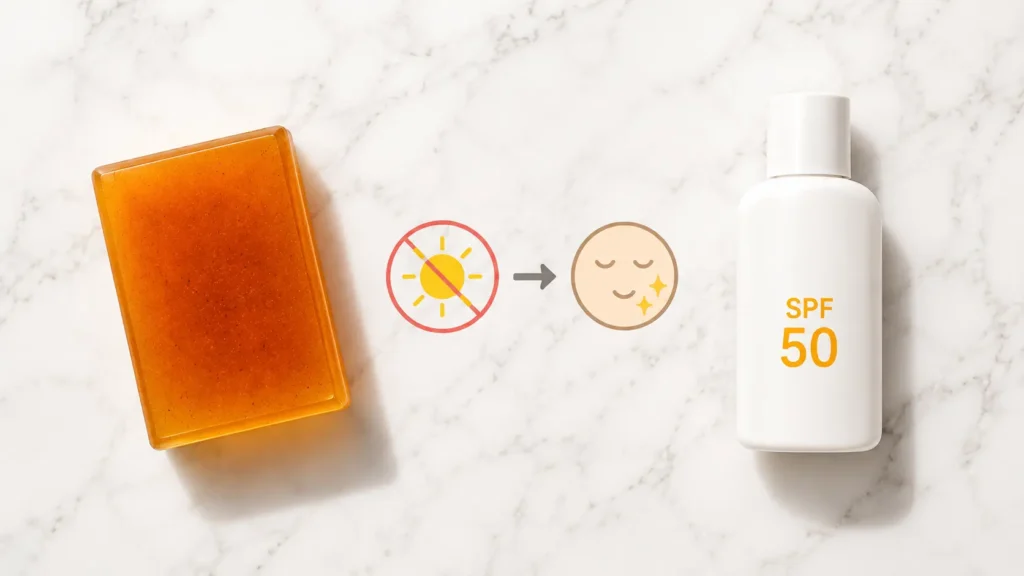
This is the single most important section in this guide, and the one most often left out of dark spot soap articles.
Every brightening ingredient in every product on this list is fighting an uphill battle if you are not wearing SPF daily. UV radiation is the primary trigger for melanocyte activity. While your brightening soap works to slow tyrosinase and block melanin transfer, a few minutes of unprotected sun exposure the same morning can reverse several days of that work.
Dermatologists are unanimous on this: brightening ingredients and sun protection are not optional extras used alongside each other — they are the same treatment, and one without the other produces significantly reduced results.
💡 Tip: Minimum SPF requirement for any dark spot treatment to work: SPF 30 broad-spectrum, applied every morning, reapplied every 2 hours in direct sun.
For deeper skin tones and melasma, SPF 50+ with iron oxide (tinted sunscreens) provides better protection against the visible light that can also trigger melasma.
Realistic Timelines for Dark Spot Fading
The most common reason people abandon effective dark spot products is expecting results in 2–4 weeks. Melanin is deeply embedded in skin cells, and those cells take time to turn over. Here are realistic, evidence-based expectations:
- Weeks 1–4: No visible change in most cases. The ingredients are working at a cellular level, but surface pigmentation has not cleared yet.
- Weeks 4–8: Minor tone improvement visible in good lighting. Post-acne marks show the earliest response.
- Weeks 8–12: Clear visible fading of shallow hyperpigmentation in most users. Sun spots beginning to lighten.
- Weeks 12–24: Significant fading for most epidermal pigmentation. Melasma may require the full 24 weeks or longer.
- Beyond 24 weeks: Very deep or hormonal pigmentation (melasma) may need additional leave-on treatments alongside soap-based actives.
🔬 Research:
A controlled clinical trial on kojic acid combined with glycolic acid demonstrated statistically significant hyperpigmentation reduction versus placebo in participants with facial dark spots after 12 weeks of twice-daily use. The study noted that results were substantially better when sun protection was used consistently throughout. [Source 3]
For a deeper explanation of how active ingredients behave in short-contact cleansers, read our guide to medicated soap for acne.
FAQ — Soap for Dark Spots
Do soaps for dark spots actually work?
Yes — with realistic expectations. Soap-based brightening actives (kojic acid, niacinamide, azelaic acid, alpha arbutin) are dermatologist-endorsed tyrosinase inhibitors and melanin transfer blockers that have clinical evidence for hyperpigmentation reduction.
In wash-off format, results are slower than leave-on serums because contact time is limited to 30–90 seconds. For best results: use for 60 seconds before rinsing, apply daily, and wear SPF 30+ every morning without exception.
How long does it take for dark spot soap to work?
Most people see early improvement at 6–8 weeks, with significant visible fading at 12 weeks. Shallow epidermal pigmentation (post-acne marks, surface sun spots) responds fastest.
Deep pigmentation like melasma may require 16–24 weeks of consistent use. No brightening soap works in days or weeks regardless of marketing claims — melanin-based pigmentation requires multiple skin cell turnover cycles to fade visibly.
Which is better: kojic acid or niacinamide soap for dark spots?
They work through different mechanisms and are most effective together. Kojic acid is a tyrosinase inhibitor — it directly slows melanin production.
Niacinamide blocks melanin transfer to surrounding skin cells.
A soap combining both (like the Good Molecules Brightening Bar) targets hyperpigmentation at two points in the melanin pathway, which consistently produces faster, more complete results than either ingredient alone.
If choosing one, kojic acid has stronger evidence for active dark spot fading; niacinamide is better for prevention and sensitive skin.
Can soap remove dark spots permanently?
Soap-based actives fade existing dark spots by inhibiting the melanin pathway and accelerating cell turnover. However, the triggers that cause dark spots — UV exposure, inflammation, hormonal activity — remain. Without ongoing sun protection and continued maintenance, dark spots will return.
Most dermatologists describe brightening treatment as ongoing management rather than permanent removal, particularly for melasma and sun damage.
Is turmeric soap effective for dark spots?
Turmeric (curcumin) has meaningful evidence for reducing hyperpigmentation through an anti-inflammatory pathway — it modulates NF-κB signalling that triggers melanocyte activity during inflammation.
Clinical reviews in 2025–2026 confirm turmeric + kojic acid soaps show visible improvement at 8–12 weeks with consistent twice-daily use and sun protection. It is most effective for post-inflammatory marks and dark spots on deeper skin tones, and works better in combination with a direct tyrosinase inhibitor.
Can I use dark spot soap on my body too?
Yes — kojic acid, turmeric, niacinamide, and alpha arbutin soaps are all suitable for body use on areas like underarms, elbows, inner thighs, and knees where friction and post-inflammatory pigmentation are common.
Body areas tend to be less sensitive than facial skin, so stronger formulas are generally well-tolerated. Apply the same SPF rule to any body area exposed to sun during dark spot treatment.
Bottom Line
The best soap for dark spots is not the most aggressively marketed one — it is the one using verified tyrosinase inhibitors or melanin transfer blockers at meaningful concentrations, in a pH-compatible base, used consistently for 8–16 weeks alongside daily SPF.
Start with kojic acid + niacinamide combination if you want the fastest results for post-acne marks. Choose alpha arbutin or azelaic acid if you have sensitive skin. Go for vitamin C soap if sun damage and dullness are the primary concerns. Add turmeric to the mix for body hyperpigmentation or deeper skin tones.
The sun protection rule is not a suggestion. It is the mechanism by which every other ingredient on this list either succeeds or fails. Apply it every morning, even on cloudy days, and the rest of the regimen becomes significantly more effective.
Sources
Sources include peer-reviewed dermatology reviews, clinical studies, and American Academy of Dermatology guidance. Product pages are used only to verify product names and ingredient-positioning, not to prove medical results.
- Zolghadri S, et al. A comprehensive review on tyrosinase inhibitors. Journal of Enzyme Inhibition and Medicinal Chemistry. 2019.
- Chang TS. An updated review of tyrosinase inhibitors. International Journal of Molecular Sciences. 2009.
- Hakozaki T, et al. The effect of niacinamide on reducing cutaneous pigmentation. British Journal of Dermatology. 2002.
- Al-Niaimi F, Chiang NYZ. Topical vitamin C and the skin: mechanisms of action and clinical applications. Journal of Clinical and Aesthetic Dermatology. 2017.
- Sauer N, et al. The multiple uses of azelaic acid in dermatology. Journal of Clinical and Aesthetic Dermatology. 2024.
- Boo YC. Arbutin as a skin depigmenting agent with antimelanogenic and antioxidant properties. Antioxidants. 2021.
- Thawabteh AM, et al. Skin pigmentation types, causes and treatment — a review. Biomedicines. 2023.
- American Academy of Dermatology. Sunscreen FAQs — visible light, tinted sunscreen, and hyperpigmentation.
Medical Disclaimer: This article is for educational purposes only. Individual results vary. Consult a board-certified dermatologist for persistent hyperpigmentation or melasma diagnosis and treatment.
RELATED ARTICLES: