

Most people choose soap by smell or by what is on sale. Then they wonder why their skin feels tight, breaks out, or stays irritated no matter what moisturiser they add on top. The soap is often the problem – not the skincare products that follow it.
Choosing the right soap is genuinely one of the highest-leverage decisions in a skincare routine.
It sets the pH of your skin for the next few hours, determines how much of your natural barrier lipids survive the wash, and decides what bacterial environment you are left with after cleansing.
Get it right and everything that follows — moisturiser, treatments, SPF — works better. Get it wrong and you are compensating for damage with every product you apply afterward.
This guide walks you through the complete process: first identifying your actual skin type, then matching it to the right soap format, ingredients, and pH level.
Every recommendation here connects to the clinical evidence already published across our soap science series.
| Quick Answer Dry skin: Choose glycerin-based or syndet bar, pH 5.5–6.5, humectant-rich — full glycerin soap guide. Oily / acne-prone: Look for salicylic acid or BPO liquid cleanser or syndet bar, pH 5.5–6.5, non-comedogenic — medicated soap guide. Combination: Choose gentle pH-balanced liquid cleanser or syndet bar, fragrance-free, mild surfactants. Sensitive / reactive: Search for colloidal oatmeal or fragrance-free aloe vera glycerin bar, syndet bar, pH 5.5 — ingredients to avoid. Eczema-prone: Choose syndet bar pH 5.5, fragrance-free, no SLS/MI/parabens, NEA Seal preferred — syndet bar science. Normal: any mild cleanser can work, but fragrance-free and pH-balanced is still the safest baseline. |
How to Identify Your Skin Type — Two Reliable At-Home Methods
Before you can choose the right soap, you need to know your actual skin type — not what you assume it is.
Many people misjudge their skin type because oiliness, dehydration, sensitivity, and barrier damage can overlap. Reviews of skin classification methods show that skin typing is not always simple and may require more than self-observation alone.[1][2]
A 2023 review in Cosmetics explains that skin type can be assessed using self-report tools, visual assessment, and bioengineering measurements such as Sebumeter and Corneometer readings. For home use, the wash-and-wait and blotting-sheet methods are practical starting points, but they are not a replacement for professional skin assessment when symptoms are persistent or confusing.[1]
Method 1: The Wash-and-Wait Test (Most Reliable)
This is the method dermatologists most commonly recommend because it removes all product variables and shows you what your skin does on its own.
- Wash your face with a very gentle, fragrance-free cleanser — nothing medicated.
- Pat dry gently. Do not apply any moisturiser, serum, or product.
- Wait 30–60 minutes. Go about your day normally.
- After the wait, observe your skin carefully in natural light.
Wash-and-Wait Test Results
| What You Observe | Likely Skin Type | Key Signal |
|---|---|---|
| Skin feels tight, dull, or flaky | Dry | Feels uncomfortable without moisturizer. |
| Skin looks shiny all over and feels greasy | Oily | Visible shine across forehead, nose, and cheeks. |
| T-zone is shiny, but cheeks are normal or dry | Combination | Different zones behave differently. |
| Skin feels comfortable with no shine or tightness | Normal | Balanced after washing and waiting. |
| Skin feels itchy, red, stinging, or irritated | Sensitive / Reactive | The cleanser itself may be triggering a reaction. |
Simple takeaway: judge your skin after waiting, not immediately after washing. Tightness, shine, redness, and T-zone behavior tell you more than the label on your current soap.
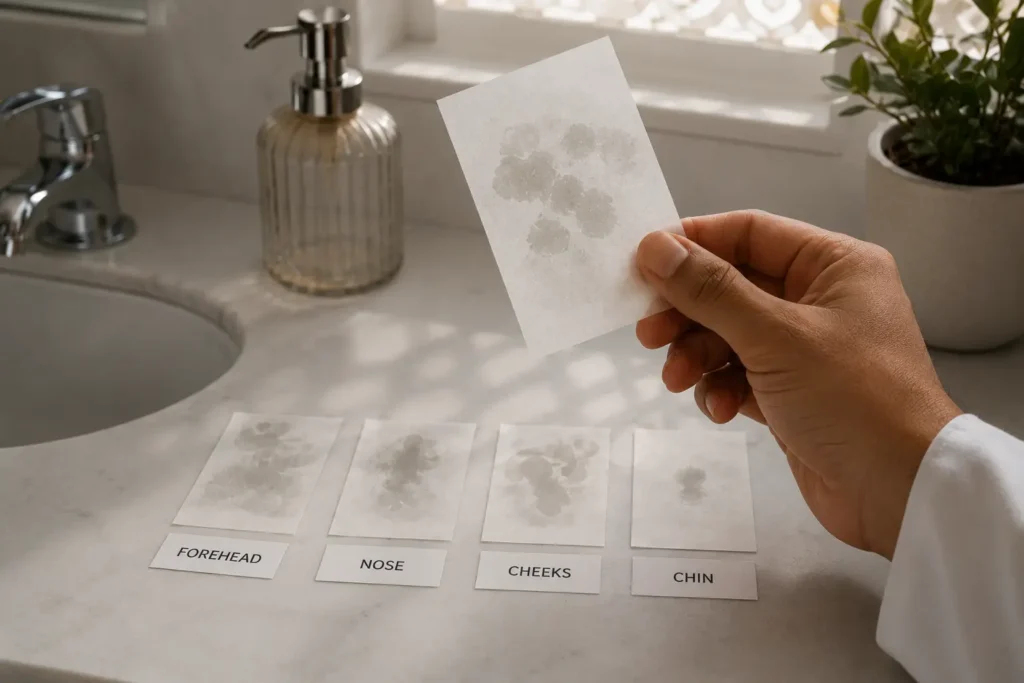
Method 2: The Blotting Sheet Test (Fastest)
Curology’s board-certified physician assistant team recommends this as a quick confirming test, particularly useful for distinguishing oily from combination skin.[3]
- Wash your face, pat dry, and wait 30 minutes — no products.
- Press a clean blotting sheet firmly against your forehead, then hold it to light.
- Repeat on nose, chin, and both cheeks — use a separate section of the sheet for each.
- Examine the oil marks on each section.
Results:
- Oil on all zones: oily skin
- Oil only from T-zone (forehead, nose, chin); dry or no oil from cheeks: combination skin
- Little to no oil from any zone: dry or normal skin
- Little oil but skin feels reactive or uncomfortable: sensitive or dry skin
| Why 80%+ of people misidentify their skin type The most common mistake is confusing dehydrated skin for oily skin. Dehydrated skin lacks water — not oil. It can feel tight and look dull, but also feel greasy on the surface because the sebaceous glands are overproducing oil to compensate for the lack of water. This skin is often both dry and oily simultaneously, and using a harsh soap in response to the oiliness makes the dehydration worse. The other common confusion: sensitive skin is not a skin type — it is a skin condition that can affect any skin type. You can have oily skin that is also sensitive, or dry skin that tolerates almost anything. |
Dry Skin — What to Look For and Why
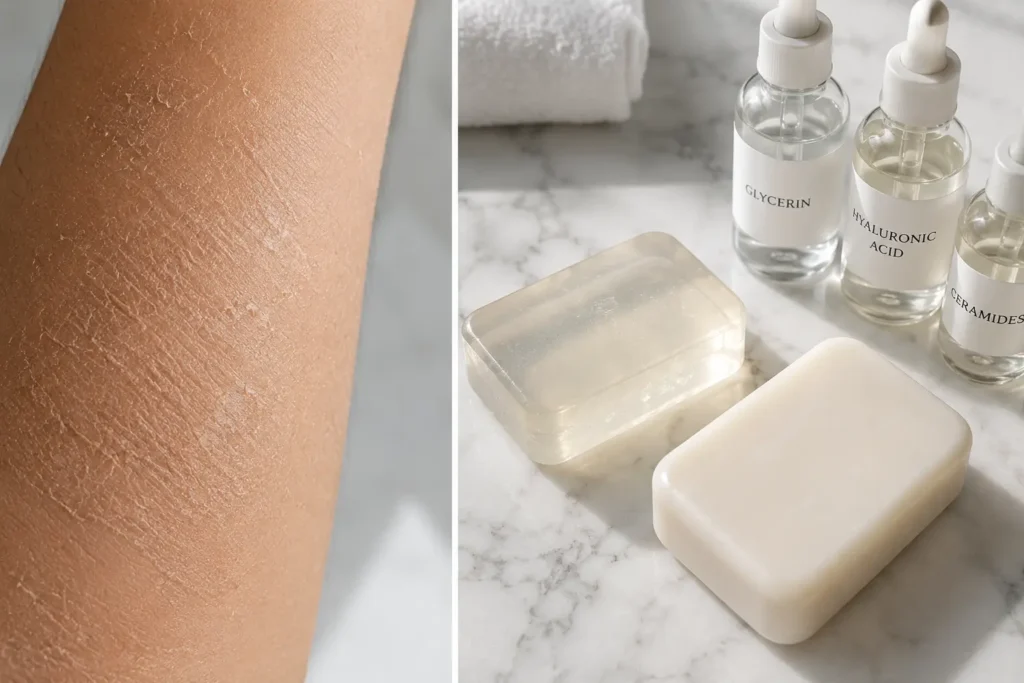
Dry skin produces less sebum than normal, has lower natural ceramide levels, and tends to have a more permeable, less water-retaining barrier. The biggest mistake people with dry skin make is using a soap that strips what little lipid protection they have left.
Traditional alkaline bar soap can be a poor match for dry skin because it may raise skin surface pH and leave the barrier feeling tight or stripped. For dry skin, the safer direction is usually a glycerin-rich bar, a fragrance-free cream cleanser, or a syndet bar that cleans without removing too much protective oil.
For deeper evidence on moisture retention and glycerin-based cleansing, read our full guide to glycerin soap vs regular soap.
Dr. Lela Lankerani, board-certified dermatologist at Westlake Dermatology, confirms the principle: “Those with dry skin need to strike a balance between cleansing and hydration.”[4] The soap should clean without leaving skin feeling tight, stripped, or uncomfortable.
| Best soap choices for dry skin Glycerin-rich bar soap (glycerin in first 3 ingredients) — humectant action retains moisture during and after cleansing Syndet bar at pH 5.5 — preserves the acid mantle and ceramide enzyme function; best overall option for dry skin Fragrance-free cream or milk cleanser (liquid format) — contains emollients and humectants alongside the cleansing agents Herbal soap with aloe vera or colloidal oatmeal base — both reduce TEWL and support barrier recovery |
| Avoid for dry skin Alkaline bar soap (pH 9–10) — most traditional bar soaps SLS as primary surfactant — strips ceramides and disrupts barrier Activated charcoal soap — adsorbs protective oils alongside sebum Antibacterial soap — triclosan and triclocarban worsen barrier function Alcohol denat. high in the INCI list — can leave already-dry skin feeling more dehydrated. Full avoidance guide with clinical evidence: Soap Ingredients to Avoid for Sensitive Skin |
Best Soap for Oily Skin — Avoid the Rebound Oil Trap
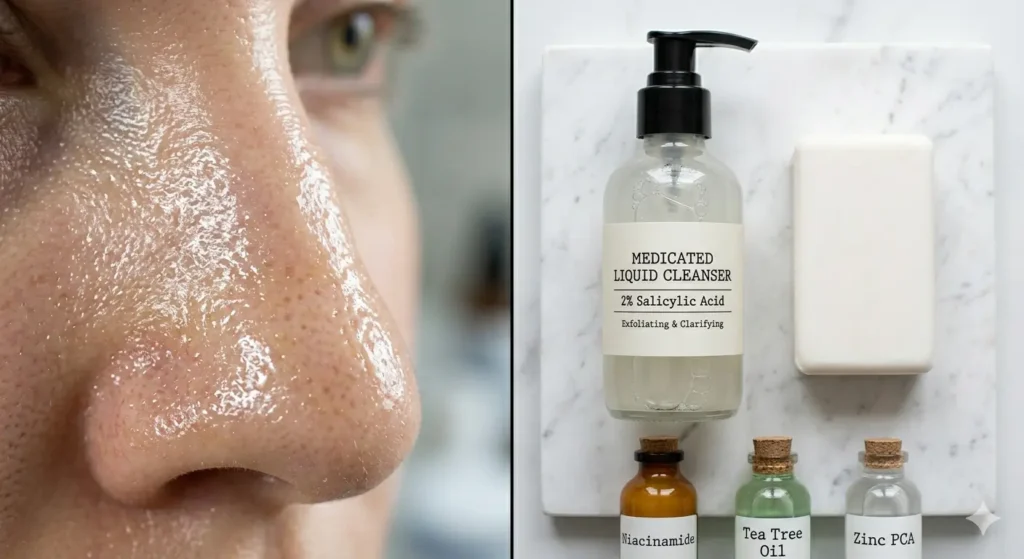
Oily skin is the most commonly mismanaged skin type — primarily because people reach for the harshest soap they can find to strip the shine, which backfires almost every time.
Here is the mechanism that matters: when you aggressively strip sebum with a high-pH alkaline soap, your skin’s sebaceous glands interpret the sudden lipid deficit as a threat and overproduce oil to compensate.
This is called rebound seborrhoea, and it is why many people with oily skin find their skin feels greasier in the afternoon if they use a very drying soap in the morning. The goal is not zero oil — it is balanced sebum levels, which requires gentle cleansing rather than aggressive stripping.
Dr. Navin Arora (board-certified dermatologist) notes that bar soaps can work well for oily skin types who prefer a simpler routine.[5] The key is pH: even for oily skin, a cleanser closer to pH 5.5–6.5 is preferable to a traditional alkaline bar at pH 9–10 — the difference is that oily skin tolerates higher pH better than dry or sensitive skin, not that high pH is ideal for it.
| Best soap choices for oily skin Salicylic acid (0.5–2%) cleanser or syndet bar — oil-soluble BHA penetrates pores and dissolves the sebum and dead cells that cause congestion Benzoyl peroxide wash (4–10%): help acne-prone oily skin by reducing Cutibacterium acnes bacteria, often shortened to C. acnes, which is one factor involved in inflammatory acne. Neem or tea tree cleanser: may support mild oily or blemish-prone skin, but essential oils can irritate sensitive users and rinse-off formulas may be less effective than leave-on treatments. Activated charcoal soap — adsorbs excess sebum; suitable for oily skin specifically (not dry or sensitive) Non-comedogenic liquid foaming cleanser — foaming cleansers remove oil effectively; look for non-comedogenic labelling For the full breakdown of salicylic acid and benzoyl peroxide in soap format: Medicated Soap for Acne: Does It Actually Work? |
| Avoid for oily skin Heavy oils in the soap base — coconut oil, shea butter at high concentration; comedogenic for congestion-prone skin Alkaline traditional soap — may leave the skin stripped and encourage rebound oiliness in some people. Over-cleansing (more than twice daily) — also triggers rebound oiliness |
Combination Skin — The Most Common, Least Discussed Skin Type
Combination skin is arguably the most prevalent skin type — characterised by an oily T-zone (forehead, nose, chin) and normal or dry cheeks.
It is also the trickiest to soap-shop for, because what is right for the T-zone (a mild oil-control active) may be too much for the drier cheeks.
The practical approach: choose a soap that is gentle enough for your driest area. A pH-balanced, fragrance-free syndet bar or gentle liquid cleanser will cleanse the T-zone adequately without over-drying the cheeks.
If T-zone oiliness remains a concern despite cleansing, address it with a targeted toner or serum on that zone specifically rather than by using a harsher whole-face soap.
| Best soap choices for combination skin pH-balanced syndet bar (pH 5.5) — gentle enough for dry cheeks, effective enough for T-zone oil control Fragrance-free gel cleanser (liquid, pH 5.5–6.5) — non-comedogenic, removes T-zone oil without stripping cheeks Gentle glycerin liquid cleanser — humectant support for dry zones while cleansing oily areas |
| The zonal approach Some dermatologists recommend using two different products — a light foaming cleanser on the T-zone and a cream cleanser on the cheeks. This works but adds complexity. For most people, a single well-chosen pH-balanced syndet bar or gentle gel cleanser is simpler and effective. See What Is a Syndet Bar? for why syndets work well for combination skin. |
Sensitive Skin — The Most Misunderstood Category
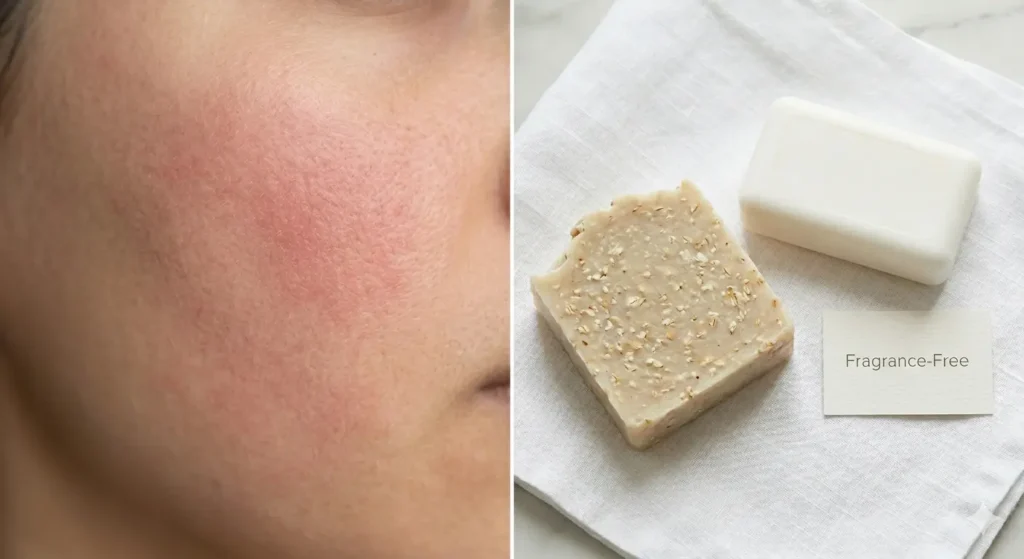
Sensitive skin is not a fixed skin type — it is a reactive state that can affect any skin type. Sensitive skin has a lower threshold for tolerating irritants, allergens, and environmental stressors.
The skin barrier is typically more permeable, and the nervous system response to stimuli is heightened. This means the same ingredient that is unremarkable for someone with normal skin can cause stinging, redness, or a full contact dermatitis reaction in sensitive skin.
The golden rule for sensitive skin and soap is: the shorter the ingredient list, the better. Every additional ingredient is an additional allergen opportunity.
Fragrance — natural or synthetic — is the single biggest trigger, present in more products than any other allergen category.
Essential oils including lavender, citrus, and tea tree all carry sensitisation risk. This is covered in full detail in our soap ingredients to avoid guide.
| Best soap choices for sensitive skin Colloidal oatmeal cleanser: useful for dry, itchy, or easily irritated skin because colloidal oatmeal is widely used as a soothing skin-protective ingredient. Avenanthramides reduce inflammation; beta-glucan supports barrier repair Fragrance-free glycerin bar soap (glycerin first 3 ingredients) — humectant without allergen risk Syndet bar pH 5.5, unfragranced — pH protection plus no preservative load Aloe vera glycerin soap, fragrance-free only — anti-inflammatory, soothing; avoid if it contains any essential oil blend |
| Avoid for sensitive skin ANY fragrance — ‘natural fragrance’, ‘essential oils’, ‘parfum’ — all high-allergen risk Methylisothiazolinone (MI/MCI) — significant contact allergen, especially in liquid soaps SLS/SLES — disrupts skin microbiome and barrier, worsening reactivity Parabens or preservatives that personally trigger irritation — not everyone reacts, but sensitive users should watch for patterns. Tea tree oil or essential oils at high concentration — patch test first, especially if you are fragrance-reactive. Antibacterial soaps — triclosan worsens sensitive skin barrier function |
Eczema-Prone Skin
Eczema (atopic dermatitis) is a skin barrier disase — the stratum corneum has structural defects that make it more permeable, more reactive, and less capable of maintaining hydration. Every wash is a potential trigger if the wrong product is used.
Eczema-prone skin usually needs especially gentle cleansing because the skin barrier is already more reactive and moisture loss is easier. Lower-pH, fragrance-free cleansers are generally safer than traditional alkaline soap for this skin type.
Traditional soap at pH 9–10 is simply not appropriate for this skin type — regardless of what other ingredients it contains.
For the full clinical evidence on pH and eczema: What Is a Syndet Bar? The Science Behind pH-Balanced Soap.
There is also the Staphylococcus aureus factor. S. aureus colonises eczema-affected skin at higher rates than healthy skin and is a key driver of flare-ups. Soaps with antimicrobial herbal ingredients — neem specifically — may help manage this, but must be fragrance-free.
For the evidence on neem, turmeric, aloe vera, tea tree, and colloidal oatmeal, read our guide to herbal soap benefits for skin.
| Best soap choices for eczema-prone skin Fragrance-free syndet bar: often one of the safest cleanser formats for eczema-prone skin because it avoids the high alkalinity of traditional soap. Colloidal oatmeal bar, fragrance-free — AAD Seal-approved; avenanthramides directly inhibit NF-kB inflammatory signalling Fragrance-free glycerin bar or liquid cleanser, pH <7 — supports barrier hydration; always check preservative list Products with the NEA (National Eczema Association) Seal of Acceptance have been reviewed for eczema appropriateness — prioritise these when uncertain. |
| Avoid for eczema-prone skin — non-negotiable Synthetic fragrance or parfum Natural fragrance / essential oil blends (lavender, citrus, tea tree at standard concentrations) Methylisothiazolinone (MI) or methylchloroisothiazolinone (MCI) SLS or SLES as primary surfactant Preservatives that personally trigger irritation or allergy. DMDM hydantoin and other formaldehyde releasers Traditional alkaline bar soap — pH 9–10 is incompatible with eczema management Activated charcoal soap — strips barrier-protective oils |
Best Soap for Normal Skin
Normal skin is genuinely the least fussy skin type — balanced oil production, intact barrier function, comfortable after washing, no chronic conditions. You have more flexibility in soap choice than any other skin type.
The one principle that applies regardless: fragrance is the most common cosmetic allergen, and normal skin can develop fragrance sensitivity at any point with repeated exposure.
A fragrance-free or lightly fragranced soap is always safer than a heavily scented one — even for normal skin that currently tolerates fragrance without issue.
Format-wise: bar soap or liquid, syndet or glycerin, herbal or plain — all work for normal skin. Focus your label-reading energy on the base pH (aim for 7 or below where possible) and the surfactant quality (mild surfactants like decyl glucoside or sodium cocoyl isethionate over SLS).
If you are deciding mainly by cleanser format, compare liquid soap vs bar soap.
The Complete Soap Selection Guide — All Skin Types at a Glance
| Skin Type | Best Soap Format | Ingredients to Seek | Avoid | Target pH |
|---|---|---|---|---|
| Dry | Glycerin or syndet Glycerin bar, cream cleanser, or syndet bar. |
Glycerin, hyaluronic acid, ceramides, aloe vera, colloidal oatmeal. | SLS, alcohol denat., charcoal, alkaline bar soap. | 5.0–6.5 |
| Oily | Oil-control cleanser Liquid foaming cleanser or syndet bar. |
Salicylic acid, niacinamide, zinc PCA, tea tree, neem, benzoyl peroxide. | Heavy oils, harsh alkaline soap, over-cleansing. | 5.5–6.5 |
| Combination | Balanced gel or syndet Gentle gel cleanser or pH-balanced syndet bar. |
Glycerin, decyl glucoside, sodium cocoyl isethionate, mild surfactants. | SLS, strong fragrance, traditional alkaline bars. | 5.5–6.5 |
| Sensitive | Fragrance-free only Colloidal oatmeal cleanser or fragrance-free syndet bar. |
Colloidal oatmeal, aloe vera, glycerin, simple fragrance-free base. | Fragrance, essential oils, MI/MCI, SLS, harsh antibacterials. | 5.0–6.0 |
| Eczema-prone | Syndet preferred Fragrance-free syndet bar; NEA Seal preferred. |
Colloidal oatmeal, glycerin, ceramide-compatible base. | Fragrance, MI/MCI, SLS, DMDM hydantoin, traditional soap. | 4.5–5.5 |
| Normal | Flexible Any mild format that does not leave tightness. |
Glycerin, decyl glucoside, SCI, mild surfactants. | Heavy fragrance and unnecessary harsh surfactants. | 5.5–7.0 |
| Acne-prone | Medicated cleanser Medicated liquid cleanser or syndet bar. |
Salicylic acid, benzoyl peroxide, sulfur, zinc pyrithione, tea tree. | Comedogenic oils, fragrance, alkaline base. | 5.5–6.5 |
| Mature | Humectant-rich Glycerin bar, cream cleanser, or gentle syndet bar. |
Glycerin, hyaluronic acid, ceramides, gentle surfactants. | SLS, alcohol denat., alkaline soap, aggressive exfoliation. | 5.0–6.0 |
Simple rule: when unsure, choose fragrance-free, pH-balanced, and non-stripping. Then adjust based on your biggest problem: dryness, oiliness, acne, sensitivity, or eczema.
How to Read a Soap Label for Your Skin Type — A Simple 5-Step Check
You now know your skin type and what to look for. Here is how to apply that to any new product label in under two minutes.
- Check ingredient 1–3. These are the most concentrated. Is the first ingredient a saponified oil (sodium palmate, sodium cocoate) — traditional alkaline soap? Or a mild surfactant (sodium cocoyl isethionate, decyl glucoside) — syndet or gentler formula? This one check tells you more than the entire front of the packaging.
- Look for ‘fragrance,’ ‘parfum,’ or ‘essential oils.’ If it appears anywhere for sensitive or eczema-prone skin: reject the product. For normal and oily skin: minimise where possible. Full allergen breakdown: Soap Ingredients to Avoid for Sensitive Skin.
- Find your target active (if applicable). For acne/oily skin: is salicylic acid or BPO in the first 6 ingredients? If it is listed 15th, the concentration is likely too low to be effective.
- Check for your avoidance list. SLS, MI, parabens, DMDM hydantoin, triclosan — scan quickly. A 10-second INCI scan is enough to eliminate products with known problem ingredients.
- Test pH if possible. Dissolve a small amount in water on a pH strip. Aim for pH 5.5–7 for most skin types. Traditional soap reads pH 9–10. This costs less than £2 for a pack of strips and removes all guesswork.
| The one-question shortcut If you can only check one thing: is the soap fragrance-free? Fragrance is the most common cosmetic allergen across all skin types, appears in more products than any other irritant, and has zero clinical benefit to the skin. For every skin type from dry to oily to normal, a fragrance-free soap is always the safer baseline choice. |
Soap and Skin Type FAQs
What soap is best for oily skin?
A salicylic acid (0.5–2%) liquid cleanser or syndet bar at pH 5.5–6.5 is the most evidence-supported choice for oily skin.
Salicylic acid is oil-soluble and penetrates pores to dissolve the sebum and dead cell plugs that cause congestion. If acne accompanies oiliness, a BPO 4–10% wash is an alternative or can be rotated.
In either case, pH matters — choose a formula below 7 to avoid triggering rebound sebum overproduction.
For acne-specific cleansers, read medicated soap for acne.
What soap should I use for dry skin?
A glycerin-rich bar soap (glycerin in the first 3 INCI ingredients) or a syndet bar at pH 5.5 are the two strongest choices for dry skin.
Glycerin’s humectant mechanism draws moisture into the stratum corneum during and after cleansing — clinically confirmed across five peer-reviewed studies.
Avoid all alkaline soap (pH 9–10), SLS-heavy formulas, and activated charcoal. For the full breakdown, read Glycerin Soap vs Regular Soap for Skin
Is bar soap or liquid soap better for sensitive skin?
Format is secondary to formulation. For sensitive skin, the priority is: fragrance-free, no methylisothiazolinone (MI), no SLS, and pH as close to 5.5 as possible.
A syndet bar meets all these criteria in bar format and also eliminates the preservative load that liquid soaps require.
A well-formulated fragrance-free liquid cleanser can also work. Traditional alkaline bar soap is the worst option for sensitive skin regardless of format.
For the full format comparison, read liquid soap vs bar soap.
For the full format comparison, read Liquid Soap vs Bar Soap: Which Is Better for Your Skin?
Can I use the same soap for my face and body?
Technically yes — but facial skin is thinner, more sensitive, and more exposed to environmental damage than body skin.
A soap appropriate for both should be fragrance-free, pH-balanced (5.5–7), and free from strong exfoliating actives like glycolic acid or high-concentration salicylic acid if you are using it on the face daily.
Body-specific medicated soaps (BPO or SA in high concentration) are better kept to body use only unless a dermatologist advises facial use.
How often should I change my soap?
You do not need to rotate soaps unless your skin changes. Skin type can change with season, age, hormones, geography, and stress.
Reassess your skin type with the wash-and-wait test every time your skin behaviour changes significantly — typically seasonally (dry in winter, oilier in summer humidity) or after major hormonal events (pregnancy, menopause, puberty).
When your skin behaviour changes, your soap choice should follow.
What does ‘pH-balanced’ on a soap label actually mean?
It means the product has been formulated to a pH closer to the skin’s natural range (4.5–5.5) than traditional alkaline soap (pH 9–10).
However, ‘pH-balanced’ is not a regulated term — any manufacturer can print it without verification. The only reliable confirmation is testing with a pH strip, or choosing a syndet bar (which by its formulation chemistry sits at pH 5.5).
For the full science, read What Is a Syndet Bar?
What is the best soap for combination skin?
A mild, fragrance-free syndet bar or gel cleanser at pH 5.5–6.5 is the most practical single-product solution for combination skin.
It is gentle enough not to over-dry the cheeks while still cleansing T-zone oil effectively.
Avoid two-product approaches unless the T-zone is significantly oilier than average — complexity increases allergen exposure risk and is harder to maintain consistently.
Complete Soap Science Reading Guide
This is the hub article for the HealthSolutionBlog.com soap and skin health series. Each article below is linked contextually throughout this guide where most relevant:
- Types of Soap and Their Benefits for Skin — Complete Guide — the full taxonomy of soap types: glycerin, herbal, syndet, medicated, toilet soap
- Soap Ingredients to Avoid for Sensitive Skin — 8 harmful ingredients, peer-reviewed evidence, printable checklist
- What Is a Syndet Bar? The Science Behind pH-Balanced Soap — why pH-balanced bars outperform traditional soap for 5 skin types
- Glycerin Soap vs Regular Soap for Skin — 5 clinical studies comparing glycerin soap on TEWL, hydration, and erythema
- Herbal Soap Benefits for Skin: 8 Ingredients Backed by Science — neem, turmeric, aloe vera, tea tree, colloidal oatmeal evidence breakdown
- Liquid Soap vs Bar Soap: Which Is Better for Your Skin? — format comparison with pH data, environmental impact, and the syndet wildcard
- Medicated Soap for Acne: Does It Actually Work? — salicylic acid, benzoyl peroxide, sulfur, zinc pyrithione — evidence and contact time reality
Sources & References
Sources include peer-reviewed skin-type classification literature and dermatology/eczema organization guidance. Supporting soap-format evidence is covered in the linked soap science articles.
- Oliveira R et al. An Overview of Methods to Characterize Skin Type: Focus on Visual Rating Scales and Self-Report Instruments. Cosmetics. 2023.
- Parraga SP et al. Skin type classifications: does the perfect assessment exist? Journal of Dermatological Treatment. 2024.
- Curology. How to determine your skin type, according to experts.
- American Academy of Dermatology. Face Washing 101.
- National Eczema Association. Seal of Acceptance Product Directory.
- Skin Type Solutions. Skin Types.
2026 HealthSolutionBlog.com. For educational purposes only. Does not constitute medical advice. For persistent skin conditions or uncertainty about skin type, consult a board-certified dermatologist.


1 thought on “How to Choose the Right Soap for Your Skin Type: The Complete Dermatologist-Guided Breakdown”